Whirlpool Oven Down in a Postwar New Dorp Kitchen? Same-day repair · New Dorp 10306
Won't heat · Igniter glows but no flame · Slow preheat after years in a tight kitchen · Display flicker · Door hinges sagging · F1-E0 from overheated controls — same-day Whirlpool gas range and oven repair in New Dorp, Oakwood, Midland Beach & Hylan Boulevard corridor
90dWarranty on every completed repair — parts & labor
Same DayMost 10306 calls diagnosed & repaired in one visit
Whirlpool Gas Oven Repair — New Dorp 10306
Whirlpool Gas Oven in a Postwar New Dorp Kitchen — What 60-Year-Old Cabinet Geometry Does to Modern Electronic Controls
New Dorp · Oakwood · Midland Beach · Grant City · Hylan Boulevard corridor
"My Whirlpool oven thermal fuse blew again — third time in two years." "Display flickers every time I run a long bake cycle in the summer." "F1-E0 keeps coming back even though the kitchen wiring is fine — we just had it inspected." "Door doesn't close right anymore — I have to lift it up to get it to seal." Four call patterns dominate every week of Whirlpool gas oven service across New Dorp, Oakwood, Midland Beach, and Grant City. There is a single architectural root behind a surprising share of them, and it has nothing to do with how the oven was made and everything to do with how the kitchen was built.
If the simple checks below don't fix it, that's when you call us. Premier Appliance Repair Staten Island charges a flat $80 diagnostic to come anywhere in 10306 — whether you are on Hylan Boulevard in New Dorp, on Mill Road in Oakwood, on Midland Avenue in Midland Beach, or near the SIRT station in Grant City. Badma diagnoses on-site and gives you the exact repair price in writing before any tool comes out of the bag. If you approve, the $80 applies toward the repair. If you don't, you pay only the $80. For 10306 specifically: when the diagnosis points at a structural cause (rear-of-range ventilation restriction driving thermal fuse failure, for example) rather than just a part, we tell you so up front and explain what fixing only the part will and will not solve.
Safety first — gas smell is not a DIY situation. If you smell gas (and not just a brief whiff when a burner first lights), turn off the range, open windows, do not flip any light switches, and call National Grid at 1-718-643-4050. They respond 24/7 free of charge and will shut off the supply if there's a leak. Only after the gas situation is verified safe, call us.
Why 10306 Postwar Kitchens Drive a Specific Whirlpool Failure Pattern
10306 is one of the most architecturally consistent residential ZIPs on Staten Island. After WWII, mid-island Staten Island filled in rapidly — Cape Cods built between roughly 1945 and 1955, ranches and split-levels through the late 1950s and into the 1960s, with infill construction continuing along Hylan Boulevard through the early 1970s. New Dorp itself was developed earliest; Oakwood expanded through the 1950s; Midland Beach grew along the inland side of Father Capodanno Boulevard; Grant City filled the corridor between New Dorp and the bay. The defining feature of all this housing is the original kitchen footprint.
Postwar kitchens were designed around freestanding gas ranges with mechanical timers and simple thermostats. The cabinet alcoves these ranges fit into were sized for that era's appliances — typically 30 inches wide, with rear clearance of just 1 to 2 inches to the wall and side clearances built tight to the adjacent cabinets. That was fine for a 1955 General Electric range with no electronics behind the cavity. It is not fine for a 2018 Whirlpool WFG535 with an electronic control board mounted on the rear cavity wall, an oven temperature sensor (WPW10181986) on the back wall reading the cavity, a thermal fuse (WP9759242) protecting against runaway temperature, and a relay control board that throws heat during the entire bake cycle. Modern Whirlpool gas ranges run hotter behind the cavity than the kitchens they sit in were ever designed to vent.
Most homeowners in 10306 have renovated the kitchen one or more times over the decades — new cabinets, new countertops, new flooring, sometimes new layouts. But unless the renovation moved the range location entirely, the fundamental rear-of-range ventilation envelope often stays original. A coat of paint and granite countertops do not change the thermal envelope behind the appliance. The result is a 1955 ventilation geometry around a 2018 thermal load.
The Tight-Kitchen Whirlpool Failure Sequence
The pattern we see across 10306 service calls follows a predictable sequence as a Whirlpool gas range ages in a postwar kitchen.
Year 1 to 5 — Everything works. Cooking heats the cavity, the rear-cavity electronics warm up during use, but the thermal load is low enough on a young oven that nothing fails. Homeowner reports zero issues.
Year 5 to 7 — First subtle symptom. Bake igniter starts taking longer to glow on cold-start; preheat to 350°F creeps up from a typical 12 minutes to 14 to 16 minutes. The igniter is aging at standard rate but the slow preheat lengthens the rear-cavity heat exposure on every cooking event. Homeowner usually doesn't call yet.
Year 7 to 10 — First real failure. Either the bake igniter ages out (glow but no flame at the 90-second mark — replacement W10918546 or W11208965), or the oven temperature sensor drifts (reads slightly low, oven overshoots set temperature, thermal fuse closer to its 130°C cutoff on each cycle), or the door gasket compresses asymmetrically letting heat escape into the front control area. Whichever happens first becomes the first service call.
Year 8 to 12 — Cumulative thermal stress on the control board. F1-E0 EEPROM communication errors start appearing intermittently after long bake cycles. They clear with a power cycle the first few times. Eventually they start persisting. Capacitors on the board age years faster than spec because of cumulative cavity heat exposure. The board needs replacement.
Year 10 to 15 — Door hinge fatigue. Years of moderate-frequency opening and closing in the original tight-clearance geometry have stretched the hinge springs. Door sags when opened, won't close fully, gasket seal is compromised on one side, F5-E0 door switch faults appear because the control reads partially-open. Both hinge and gasket usually replaced together.
Not every 10306 kitchen sees every step of this sequence — usage patterns vary, some kitchens have been renovated with modern range hood ventilation that helps, and some homeowners replace the entire range before the failure cascade reaches the control board. But the pattern is consistent enough that on a 10306 service call we know roughly what to expect from the model number, the install date, and one question on the phone: "is the range in the original kitchen footprint, or has the kitchen been substantially relayed since installation?"
Whirlpool Gas Oven Won't Heat — How the Igniter Test Reads in 10306 Kitchens
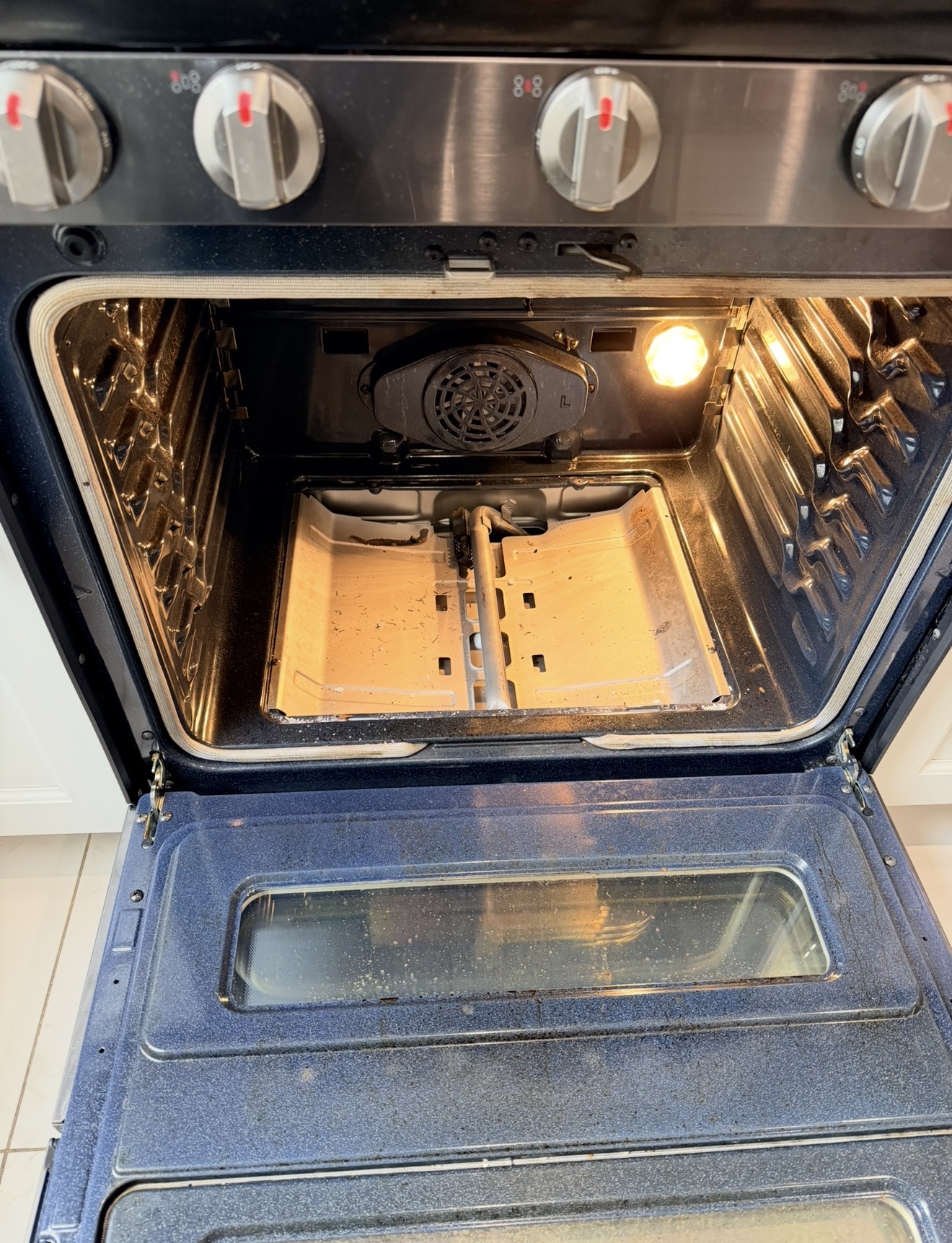
Beneath all the thermal-environment factors, the underlying cause that crosses every Whirlpool gas oven sooner or later is bake igniter degradation. Set the oven to Bake 350°F with the oven light on, close the door, and watch through the window with a phone timer running. The sequence: within 30 to 60 seconds, a bright glow at the bottom of the cavity, ramping red → orange → white-hot. By around the 1-minute mark, the gas safety valve clicks open and a steady blue flame runs across the burner tube. By 90 seconds total, the burner is fully lit. If 90 seconds pass with the igniter glowing but no flame appears, the igniter is no longer drawing the threshold current the safety valve needs.
Mechanical detail: the Whirlpool gas oven igniter does two jobs simultaneously. It heats the gas to ignition temperature, and it acts as a current sensor that tells the gas safety valve when to open. As the igniter ages, its silicon-carbide element develops microcracks, its resistance climbs, the current it pulls drops, and at some point the safety valve no longer receives the threshold signal. Multimeter spec: a healthy Whirlpool hot-surface oven igniter draws 2.5 to 3.6 amps under load. Below approximately 2.7 amps, the safety valve will not open. Below 2.0 amps, the igniter is fully spent. Resistance check at room temperature reads 80 to 175 ohms healthy. The current-generation Whirlpool oven igniter is W10918546 and fits most current WFG and WEG gas ranges in 10306 kitchens — including WFG535S0LS, WEG745H0FS, WEG750H0HZ, WFG775H0HZ, and WFG975H0HZ. The newer WFG320 and WFG505 production series uses W11208965. Both fit most KitchenAid (KFGG500ESS, KFGS500ESS, KSGB900ESS), Maytag, and Amana gas ranges built by Whirlpool — sister brands on the same Whirlpool platform.
Why "Igniter Glows but No Flame" Is Almost Never the Gas Valve
A common diagnostic mistake — both DIY and from less-experienced techs — is to chase the gas safety valve when the symptom is glow-but-no-flame. The reasoning sounds right: "the gas isn't reaching the burner, so the valve must be bad." It almost never is. The gas safety valve in a Whirlpool gas oven is electrically simple — a solenoid that opens when it sees enough current through the igniter circuit. Valves rarely fail; igniters routinely degrade. When the igniter ages, its resistance climbs and the current drops below the valve's threshold. The valve is doing exactly what it should — refusing to open without confirmation that something hot is waiting to ignite the gas. Replacing the gas safety valve (98014893) on a glow-but-no-flame symptom replaces a working part. The actual fix is the igniter.
The Thermal Fuse Story — Why Replacement Alone Doesn't Fix the Pattern
Whirlpool oven thermal fuses (WP9759242 covers most current units) are 130°C single-use safety devices. They open the oven heating circuit if cavity wall temperature exceeds the cutoff. They are designed to operate near but not at their threshold during normal cooking. A first thermal fuse failure on a 10-year-old Whirlpool gas range is not unusual — components age, and a $20 fuse opening to protect everything else is the system working as designed.
What concerns us in 10306 specifically is repeat thermal fuse failures. When a fuse blows, gets replaced, and then blows again within months, something is pushing cavity temperature higher than spec. Three drivers we typically find in postwar New Dorp kitchens.
Driver 1 — restricted rear-of-range ventilation. The space behind the range traps heat against the cabinet. That heat radiates back through the rear cavity wall, raising the temperature near the fuse, and pushing it closer to its 130°C cutoff during normal cooking. A range that operates fine in a newer kitchen with proper rear clearance can blow thermal fuses repeatedly when sitting in a 1955-design alcove with 1 inch of rear clearance. Diagnostic: measure the actual rear gap and check whether airflow is blocked.
Driver 2 — drifting oven temperature sensor. The Whirlpool oven temperature sensor (WPW10181986) is an RTD on the rear cavity wall. As it ages and its resistance curve drifts, it can read slightly low. The control board responds by overshooting set temperature on each cycle to compensate. Homeowner doesn't notice — food still cooks fine — but the cavity temperature peaks higher than designed, and the thermal fuse sits closer to cutoff every cycle. Sensor replacement plus fuse replacement is the durable fix.
Driver 3 — worn door gasket. The door gasket (W11542153) seals the cavity opening. When it compresses or tears, heat escapes the cavity into the front control area where, on some Whirlpool models, the thermal fuse sits. Paradoxically, the fuse can fail from heat coming around the cavity rather than through it. Gasket replacement alongside fuse replacement is the fix on these units.
We diagnose all three on the same visit and tell you which is the actual root cause before quoting parts. Replacing a $20 thermal fuse without addressing the underlying thermal driver means another fuse failure within months — and that pattern doesn't stop until the actual cause is fixed.
The Sagging Door Story — Original Kitchen Geometry Still Costs You
Postwar Cape Cod and ranch kitchens were designed for compactness. Oven doors had less swing clearance than modern designs assume — the door swept past adjacent cabinets, walls, or counter overhangs with only a few inches to spare. Years of moderate-frequency opening and closing in this geometry put non-trivial loading on the door hinge springs every cycle, especially when the user has to angle the door slightly or hold it back to clear an adjacent obstruction. Hinge spring fatigue accumulates faster than in newer kitchen designs where the door has full unrestricted swing.
The pattern we see in 10306: door starts to drop below horizontal when fully opened around year 12 to 15 in the original kitchen footprint. Homeowner adapts by lifting and pushing on close to make the gasket seal. The gasket itself (W11542153) compresses asymmetrically — flatter on the side where the door has been sagging, more rebound on the opposite side. Eventually the F5-E0 door switch fault appears because the control reads the door as partially open. At this point both the hinge assembly and the gasket need replacement. We typically catch this around the same age as the bake igniter end-of-life, so a 12-year-old Whirlpool gas range in a postwar 10306 kitchen often gets igniter, gasket, and hinges all replaced on a single visit — not because we are upselling but because all three components have aged into their service window simultaneously.
Why We Don't Quote Prices Over the Phone
A lot of shops quote on the phone and change the price when they arrive. We don't. In 10306, two ovens with "won't heat" can need different parts: a weak bake igniter, a drifting temperature sensor, a thermal fuse blown by a pattern of restricted ventilation, or a relay on the oven control board aged out from years of cumulative cavity heat. Two ovens with "thermal fuse keeps blowing" can need any of three different combinations of parts depending on which thermal driver is actually doing it. The only way to know is to test on-site, and the postwar-kitchen diagnostic checklist is slightly longer than other ZIPs because we measure rear-of-range clearance and inspect for thermal patterns in addition to standard component testing. You pay $80 for the diagnosis. You get the exact repair price in writing. You decide whether to proceed. If yes, the $80 is credited toward the repair. If no, you pay only the $80 and we leave. Same deal for every customer in New Dorp, Oakwood, Midland Beach, and Grant City.
KitchenAid, Maytag, and Amana — Same Whirlpool Platform, Same Postwar-Kitchen Behavior
Whirlpool Corporation has owned KitchenAid since 1986, Maytag and its sister brands (Amana, Magic Chef, Jenn-Air) since 2006. From a service standpoint, the parts on a KitchenAid KFGG500ESS gas range, a Maytag freestanding gas, or an Amana gas oven are largely the same as on the equivalent Whirlpool — same igniters (W10918546, W11208965), same temperature sensors (WPW10181986), same thermal fuses (WP9759242), same door gaskets (W11542153). In 10306 postwar kitchens, the underlying tight-cabinet thermal environment doesn't care which badge is on the front of your range — all four sister brands show the same age-out cascade in the same kitchen geometries. We service all four at the standard $80 diagnostic. Bring the model number from the door frame label and we tell you which Whirlpool platform underlies it.
Whirlpool also builds a small electric range line, and we do see them occasionally in renovated 10306 kitchens. Same diagnostic process; failure modes shift from igniter and gas valve to bake elements and oven relay control.
Why Choose Premier
Premier vs Whirlpool Service Center
Factor
Whirlpool Service
Premier Appliance
Arrival in New Dorp
5–14 day wait
Same-day
Free phone advice before a visit
Queue & script
Always
Diagnostic fee
$100–150+
$80, applied
Price quoted before work starts
Not always
Always in writing
Warranty
Varies
90-day guarantee
Weekend availability
Weekdays only
Mon–Sun
Honest, Transparent Pricing
What a Visit Costs
Diagnostic
$80
On-Site Diagnosis
Flat fee, anywhere in 10306. Covers travel, complete on-site diagnosis of your Whirlpool, KitchenAid, Maytag, or Amana gas range, oven, or wall oven — including the bake igniter timing test, current-draw measurement, rear-of-range ventilation clearance check, and thermal fuse root-cause analysis on repeat failures — and a written repair quote. Applied toward the repair if you proceed.
$0
Hidden Fees
No weekend charge. No trip fee. No fuel surcharge. No North Shore surcharge. Price quoted before work starts and locked in.
How the repair price is determined: After diagnosis, Badma gives you the exact price in writing. It depends on which part failed and your specific Whirlpool, KitchenAid, Maytag, or Amana gas model — a bake igniter, an oven temperature sensor, a thermal fuse, a door hinge assembly, a door gasket, a gas safety valve, and a control board are all different repairs at different prices. We don't guess over the phone because two ranges with the same symptom can need different parts. You approve the price before any work starts. Every completed repair carries a 90-day parts and labor warranty.
Whirlpool F-Code Diagnostics in 10306 Postwar Kitchens
New Dorp, Oakwood, Midland Beach, and Grant City sit in tight postwar kitchen footprints designed around 1955-era ranges. Modern Whirlpool electronic boards run hotter than these kitchens were ever built to vent. That shifts which F-codes appear most: F1-E0 EEPROM faults from thermal-stress aging and recurring thermal fuse failures (no F-code, no-heat symptom) are over-represented vs newer-construction ZIPs. Door switch F5 codes from sagging hinges in original-geometry doors also appear earlier here.
No Code · Thermal FuseThermal Fuse Blown — No Heat, No Display Code (Most Common 10306 Repeat Failure)▼
The Whirlpool oven thermal fuse (WP9759242) is a 130°C single-use safety device that opens the heating circuit when cavity temperature exceeds the cutoff. When it blows, the oven simply doesn't heat — and the display does not show an F-code because the fuse is upstream of the control's diagnostic logic. This is the most common no-F-code failure pattern we see in 10306 postwar kitchens, and it almost always indicates an underlying thermal driver pushing the cavity past spec.
Confirm the symptom: oven controls work, display normal, but no heat reaches the cavity. Bake mode does nothing. Broil mode does nothing. Cooktop burners ignite normally.
Check the breaker — half-tripped breakers can mimic this. Push firmly OFF for 30 seconds, then firmly ON.
If breaker is fine and the symptom persists, the thermal fuse has opened. Replacement requires removing the rear panel — not a DIY repair.
Critical: replacement fuse alone without addressing the underlying thermal driver means another fuse failure within months. We diagnose three potential drivers (rear ventilation restriction, drifting temperature sensor WPW10181986, worn door gasket W11542153) on the same visit and tell you which is the actual cause.
Same-visit fuse + driver-component repair on most Whirlpool, KitchenAid, Maytag, and Amana gas ranges. Call (929) 261-4444 →
No Code · Bake IgniterBake Igniter Glow Test — Won't Heat With No F-Code Showing▼
The dominant Whirlpool gas oven failure across all of Staten Island. Display normal, controls responsive, cooktop fine — but the oven cavity stays cold. Cause is almost always a weakening bake igniter that has aged past the threshold needed to open the gas safety valve.
Cold oven, set Bake 350°F, oven light ON, close the door, start a timer.
Watch through the window. By 30-60 seconds you should see a glow at the bottom of the cavity, ramping red → orange → white-hot. By 90 seconds total, the safety valve should click and a steady blue flame should run across the burner tube.
Glow but no flame at 90 seconds = weak igniter. Replacement is the fix.
Glow stops at red or orange and never brightens to white = igniter is on its way out, weeks at most.
No glow at all by 60 seconds = dead igniter, broken wire, or open-circuit element.
Whirlpool oven igniter W10918546 covers most current Whirlpool gas ranges including those in postwar 10306 kitchens; W11208965 fits the newer WFG320/WFG505 series. Both ride on the truck. Call (929) 261-4444 →
F1-E0 / F1-E1EEPROM Communication or Checksum — Thermal-Stress Aging in Tight Kitchens▼
F1-E0 indicates the oven control board cannot read its EEPROM calibration memory. F1-E1 is a checksum error on the same memory. In 10306 postwar kitchens, both codes appear earlier than spec because the rear-of-range ventilation envelope was designed for 1955-era mechanical-timer ovens, not for modern electronic control boards that run warm during long bake cycles. Cumulative cavity heat exposure ages the EEPROM and adjacent capacitors years faster than they would in a newer kitchen with proper rear airflow.
Power cycle at the breaker for a full 5 to 10 minutes. F1-E0 and F1-E1 respond well to long power cycles.
Wait at least 1 minute after power returns before pressing any button.
If the code clears and stays clear, the trigger was a transient. Monitor for a few days.
If F1-E0 returns within hours or days, the EEPROM has hard-failed. Before quoting a control board, we measure rear-of-range ventilation clearance and tell you whether airflow improvements (a simple ventilation gap behind the range) might extend the next board's service life.
This kind of structural diagnosis is the difference between a one-and-done repair and a recurring issue. Call (929) 261-4444 →
F5-E0Door Switch Fault — Often Sagging Hinges in Postwar Kitchens▼
F5-E0 means the control board reads the oven door as partially open when it should be closed. Standard cause is a failed door switch or its wiring. In 10306 specifically, a non-standard cause appears more often: door hinge spring fatigue from years of moderate-frequency use in original tight-clearance postwar kitchen geometry. The door physically sags below horizontal when opened and doesn't fully close on its own — gasket seal is compromised on one side, and the door switch on that side reads "open" because the door is in fact 1-2 mm out of the fully-closed position.
Open the door fully. Does it stay at 90 degrees on its own, or does it sag below horizontal? Sag = hinge springs fatigued.
Inspect the perimeter gasket for asymmetric compression — flatter on the sagging side.
Open and close the door firmly several times — sometimes a stiff hinge needs to be cycled to register closed.
If the door clearly sags or won't fully close, both the hinge assembly and the gasket (W11542153) need replacement.
If hinges are fine and the door closes properly, the issue is the door switch itself or its wiring — different repair, also same-visit. Call (929) 261-4444 →
F3-E0 / F3-E1Oven Temperature Sensor — Open or Shorted▼
F3-E0 means the sensor circuit is open. F3-E1 means the sensor or its wiring has shorted. Either way, the control board can no longer read oven temperature and shuts off heat to prevent unsafe operation. In postwar 10306 kitchens, sensor failures sometimes correlate with the thermal-stress pattern — a sensor that has spent years overheating in a tight rear-cavity environment ages faster than spec.
Power cycle at the breaker for 5 minutes — clears soft glitches.
Set Bake 350°F. If F3-E0 or F3-E1 returns within the first minute, sensor or wiring has hard-failed.
If the code cleared and doesn't come back during a full bake cycle, the issue was a transient.
Sensor (WPW10181986) is the standard fix; same-visit replacement. On units where sensor drift caused thermal fuse failure as the precipitating event, we replace both. Call (929) 261-4444 →
F2Runaway Temperature Cutoff — Stop Using the Oven Until Inspected▼
F2 alone (without an E-suffix) signals that cavity temperature climbed past the safe upper limit and the runaway-protection logic intervened. Different from F2-E0/F2-E1 which point at the touch keypad. A bare F2 indicates either welded relay contacts on the control board (the bake or broil relay closed and stuck closed, feeding heat continuously regardless of what the controls were asking for), or a control board logic fault. In 10306 postwar kitchens, welded relays are sometimes the cumulative result of years of thermal stress on the board.
Range breaker to OFF — do not retry the oven.
Allow a full cool-down period of two hours minimum.
Call us. We test relay contact integrity, the temperature sensor (WPW10181986) for a stuck-low reading, and check for any wiring short. Replacement of the oven control board is the typical repair path.
F2 is the rare code where same-day matters for safety reasons. Call (929) 261-4444 →
F2-E0 / F2-E1Touch Keypad Stuck or Disconnected▼
F2-E0 means the control reads a button as continuously pressed when nothing is being pressed — almost always food splatter, grease film, or moisture on the panel. F2-E1 means the touch panel ribbon cable has lost connection to the control board. Whirlpool touch panels are generally reliable but moisture and grease build-up cause issues over time, particularly on units that share the kitchen with a frequently-used cooktop right below the panel.
Wipe the touch panel with a damp microfiber cloth — never spray cleaner directly onto it.
Inspect each button area in good light for any chip, crack, or physical depression.
Power cycle at the breaker for 5 to 10 minutes.
If F2-E0 clears, you are done. If it returns despite a clean panel, the membrane switch or its ribbon to the board has failed.
F4-E1 indicates a problem with the meat probe, the probe receptacle in the oven cavity, or the probe circuit on the control board. Even households that don't use the meat probe deliberately can get this code if the receptacle accumulates grease residue from years of cooking splatter, bridging the contact pins.
Remove any meat probe inserted in the receptacle.
Inspect the receptacle for grease, baked-on residue, or moisture across the contact pins.
Power cycle at the breaker for 5 minutes.
If F4-E1 throws even with no probe present and a clean receptacle, the receptacle wiring or control input has failed.
Probe-receptacle cleaning sometimes resolves it; otherwise probe assembly replacement is straightforward and same-visit. Call (929) 261-4444 →
PF / SabPower Failure Recovery or Sabbath Mode▼
PF means the oven detected a brief interruption to its power supply — press Cancel and reset the clock. A single PF after a confirmed Con Edison outage is normal. Sab indicates Sabbath mode is active. The display will show "Sab" and most controls will not respond. Hold the Sabbath button (or the button combination per your user manual for your specific Whirlpool, KitchenAid, Maytag, or Amana model) to exit. Call (929) 261-4444 →
Common Whirlpool Postwar-Kitchen Problems — New Dorp 10306
Whirlpool Issues We Fix Most Often in 10306 Postwar Kitchens
Whirlpool oven thermal fuse keeps blowing — third or fourth time▼
The signature 10306 repeat-failure pattern. Whirlpool oven thermal fuses (WP9759242) are 130°C single-use safety devices designed to operate near but not at their cutoff during normal cooking. A first failure on a 10-year-old range is unremarkable. A second failure within months means something is pushing cavity temperature higher than spec, and a third failure points clearly at an underlying thermal driver.
Confirm the symptom: oven controls work, display normal, but no heat reaches the cavity. Cooktop burners ignite normally.
If a previous repair replaced the thermal fuse alone without checking ventilation, sensor drift, or door gasket, the underlying driver is still active.
In 10306 postwar kitchens, three drivers account for nearly all repeat thermal fuse failures: restricted rear-of-range ventilation, drifting oven temperature sensor (WPW10181986), worn door gasket (W11542153). We test all three.
Replacement fuse (WP9759242) plus the driver-component fix. Without addressing the driver, expect another fuse failure within months.
This is exactly the kind of repair where on-site diagnosis matters more than parts cost — the wrong fix is cheap but doesn't solve anything. Call (929) 261-4444 →
The most common Whirlpool gas oven complaint on units 6 to 10 years old. The cause in the vast majority of cases is a weakening bake igniter. In 10306 postwar kitchens with restricted rear ventilation, igniter end-of-life sometimes arrives 1 to 2 years earlier than calendar-spec because of cumulative cavity heat exposure. Run this test before calling:
Set oven to Bake 350°F. Turn on the oven light. Watch through the window with a phone timer running.
Within 30 to 60 seconds you should see a bright glow at the bottom of the oven — the igniter ramping from red through orange toward white-hot.
By around the 1-minute mark, a steady blue flame should appear across the burner tube.
Glow but no flame at the 90-second mark = weak igniter. Replacement is the fix.
No glow at all by 60 seconds = dead igniter, broken wire to the igniter, or open circuit.
Multimeter spec: a healthy Whirlpool hot-surface igniter draws 2.5 to 3.6 amps; below approximately 2.7 amps the safety valve will not open.
Bake igniter is W10918546 on most current Whirlpool gas ranges or W11208965 on the newer WFG320/WFG505 series — Badma carries both on the truck. Same igniters fit KitchenAid (KFGG500ESS, KFGS500ESS, KSGB900ESS) and Maytag/Amana sister-brand gas ranges. Call (929) 261-4444 →
Whirlpool oven door sags or won't close fully — original kitchen geometry issue▼
10306-signature failure. Postwar Cape Cod and ranch kitchens were designed with less oven door swing clearance than modern designs assume. Years of moderate-frequency opening and closing in original tight-clearance geometry stretches hinge springs faster than spec.
Open the door fully. Does it stay at 90 degrees on its own, or does it sag below horizontal?
If it sags, hinge springs have fatigued — the symptoms below will all follow.
Symptoms: door doesn't close on its own, requires lift-and-push to seal; gasket compromised on one side; oven loses heat faster than it should during a bake cycle; F5-E0 door switch faults appear.
Inspect the perimeter gasket (W11542153) for asymmetric compression — flatter on the side where the door has been sagging.
Fix is door hinge replacement plus often the gasket. Both same-visit on most Whirlpool, KitchenAid, Maytag, and Amana platforms.
If your range has been in the same New Dorp kitchen footprint 15+ years, mention it on the call — we will bring matching hinge assembly and gasket. Call (929) 261-4444 →
Whirlpool display flickers after long bake cycles or shows F1-E0 in summer▼
Tight rear-of-range ventilation in 10306 postwar kitchens drives a specific F1-E0 / F1-E1 EEPROM-fault pattern that doesn't appear in newer-construction ZIPs. Modern Whirlpool electronic boards rely on natural convection through the rear cavity for cooling. When the range sits in a 1955-design alcove with limited rear clearance, board temperatures climb during long bake cycles and EEPROM and adjacent capacitors age faster than spec.
Power cycle at breaker for 5 to 10 minutes. Wait 1 minute after power returns before pressing anything.
Pattern A: F1-E0 appears after a long Sunday roast or holiday baking session, clears on power cycle, doesn't reappear for weeks. Manageable for now — board is showing thermal stress but not yet failing.
Pattern B: F1-E0 appears multiple times per week, sometimes during shorter cycles, persists across power cycles. EEPROM has hard-failed and the board needs replacement.
Before quoting a control board, we measure rear-of-range ventilation clearance and tell you whether airflow improvements (a simple ventilation gap) might extend next board service life.
Replacing a $400 control board on a unit that will fail again in 3 years from the same thermal driver is not the right answer. We tell you the structural picture before the parts picture. Call (929) 261-4444 →
Whirlpool oven preheats but never reaches 350°F or 400°F▼
Different from "won't heat at all." Here the oven heats some, the display climbs, but never actually reaches the set temperature, and food cooks unevenly. Two main causes in postwar 10306 kitchens:
Drifting oven temperature sensor. The Whirlpool oven sensor (WPW10181986) is an RTD on the rear cavity wall. As it ages, its resistance curve drifts and the control reads falsely high temperature, shutting off heat early. Quick test: $6 oven thermometer on middle rack, set Bake 350°F, wait 20 minutes, compare actual to displayed. More than 35°F low = sensor needs replacement.
Worn door gasket combined with restricted ventilation. The W11542153 gasket compresses over years; when it fails, heat escapes the cavity into the front control area faster than the burner can replace it. Postwar 10306 kitchens with sagging doors often have asymmetric gasket compression, accelerating the heat loss.
If the sensor is fine and the gasket is good, a weak bake igniter cycles the burner less efficiently — sometimes the third cause.
This is utility-company territory before it is appliance-repair territory. A brief whiff at burner ignition is normal. A persistent gas smell when nothing is cooking is not.
Knobs to OFF, including any clock-timer cooking that may have started.
Cross-ventilate — open kitchen windows plus a door on the opposite side if practical.
Avoid any electrical switching whatsoever — refrigerator door, light switch, garage opener, range hood fan; each can spark.
If the odor is strong, exit the residence with everyone present.
From outside or a neighbor's phone: National Grid gas emergency, 1-718-643-4050. Free 24-hour response.
Only after National Grid has cleared the residence: (929) 261-4444 for the appliance-side repair.
In 10306 postwar kitchens specifically, gas line connectors at the back of the range have sometimes been moved or extended during multiple decades of kitchen renovations — worth mentioning to National Grid if the smell is at the connection rather than the burner. Call after the safety clearance →
Whirlpool gas oven only lights when a stovetop burner is on first▼
A diagnostic-grade clue most homeowners don't realize they're seeing: the oven only fires the burner when one of the cooktop burners is already lit. The mechanism is straightforward — a stovetop burner draws a small additional current through the same circuit, which can be just enough to push a borderline-weak bake igniter past the threshold the gas safety valve needs to open.
Confirm the symptom: cold oven start, set Bake 350°F, wait the full 90 seconds — does the burner ignite? If no, light a single cooktop burner and watch the oven window. Does the bake burner now light?
If yes, that confirms a weak oven igniter. The igniter is glowing and pulling some current, just not enough on its own to open the safety valve.
The igniter is W10918546 on most current Whirlpool gas ranges or W11208965 on the newer WFG320/WFG505 production series — both stocked on the truck.
This symptom catches a degrading igniter early. Catch it now and the oven keeps working through the holidays; ignore it and the oven will fail completely within a few weeks. Call (929) 261-4444 →
Whirlpool oven shuts off mid-cycle — heat stops, display goes blank or shows F-code▼
Mid-cycle shutdowns in 10306 postwar kitchens almost always trace to the thermal-stress pattern. Three common scenarios:
Heat stops, display blank, breaker possibly tripped. Either the thermal fuse (WP9759242) opened from over-temperature, or a breaker half-tripped. Check breaker first.
Heat stops, display shows F2. Runaway temperature cutoff fired — stop using the oven and call us. Usually welded relay contacts on the control board.
Heat stops, display shows F1-E0 or F3-E0. Either control board EEPROM glitch from cumulative thermal stress, or oven temperature sensor open/shorted. Power cycle for 10 minutes; if the code returns, board or sensor needs replacement.
Mid-cycle shutdowns in 10306 are not random — they almost always point to the underlying thermal-management pattern in postwar kitchens. We diagnose the actual root cause before quoting any parts. Call (929) 261-4444 →
Your Technician
About Badma
BadmaOwner & Technician · Premier Appliance Repair Staten Island LLC
4+ Years on Whirlpool Gas Ranges Across Postwar Mid-Island KitchensHundreds of Whirlpool WFG and WEG gas ranges, Whirlpool gas wall ovens (WOS, WOD), and KitchenAid, Maytag, and Amana sister-brand gas units diagnosed in postwar New Dorp, Oakwood, Midland Beach, and Grant City. 99% of 10306 kitchens are gas; tight-cabinet thermal failure patterns are what Badma sees every week.
Bake Igniter Glow Test & Current-Draw Diagnosis On-SiteWhirlpool gas oven igniter timing test through the window, then multimeter check of igniter current under load. A healthy hot-surface igniter draws 2.5 to 3.6 amps; below ~2.7 amps the gas safety valve will not open. We catch borderline igniters before they fail completely.
Postwar Kitchen Thermal Diagnostic on Every 10306 VisitRear-of-range ventilation clearance measurement, thermal fuse failure root-cause analysis (ventilation, sensor drift, or gasket), F1-E0 thermal-stress aging assessment. We diagnose structural drivers before quoting parts that won't fix recurring failures.
Both Whirlpool Oven Igniter Generations + Postwar Wear Parts on the TruckW10918546 (covers most current Whirlpool gas ranges including WFG320M0BS, WFG505M0BS, WFG535S0LS, WEG745H0FS, WEG750H0HZ) and W11208965 (newer WFG320/WFG505 production series). Plus WP9759242 oven thermal fuse (the part most-replaced after igniters in postwar 10306 kitchens due to thermal cycling), WPW10181986 oven temperature sensor, W11542153 door gasket, WPW10107820 door lock motor, 98014893 gas safety valve.
$80 Flat Diagnostic — Exact Price AfterWritten quote before any work starts. No phone guesses, no surprise fees. In postwar kitchens we sometimes recommend pairing related at-risk components (igniter + gasket + hinges on a 12-year-old unit reaching multiple end-of-life intervals at once) and explain why on-site so you can decide.
90-Day Parts & Labor WarrantyEvery completed repair — backed by Premier Appliance Repair Staten Island LLC directly. No third-party paperwork.
The Repair Process
How a Whirlpool Oven Repair Visit Works in Postwar 10306
1
Call or Book — Share Your Model and Symptom
Call (929) 261-4444 or book online. Have three things ready: the Whirlpool, KitchenAid, Maytag, or Amana gas model number from the label inside the door frame (it starts with WFG, WEG, WOS, WOD, WOSA, KFGG, KFGS, KSGB, MGR, or AGR), what you are actually seeing (won't heat, igniter glows but no flame, thermal fuse blew again, F1-E0, door sagging), and roughly when the kitchen was last substantially renovated. That third item matters specifically in 10306 — if the range sits in original postwar cabinet geometry, the diagnosis often goes differently than if the kitchen has been fully relayed. Some 10306-typical issues — Sabbath mode accidentally activated, single PF after a confirmed outage, surface burner clicks fixed by basic cleaning — get solved over the phone in 5 minutes at no cost.
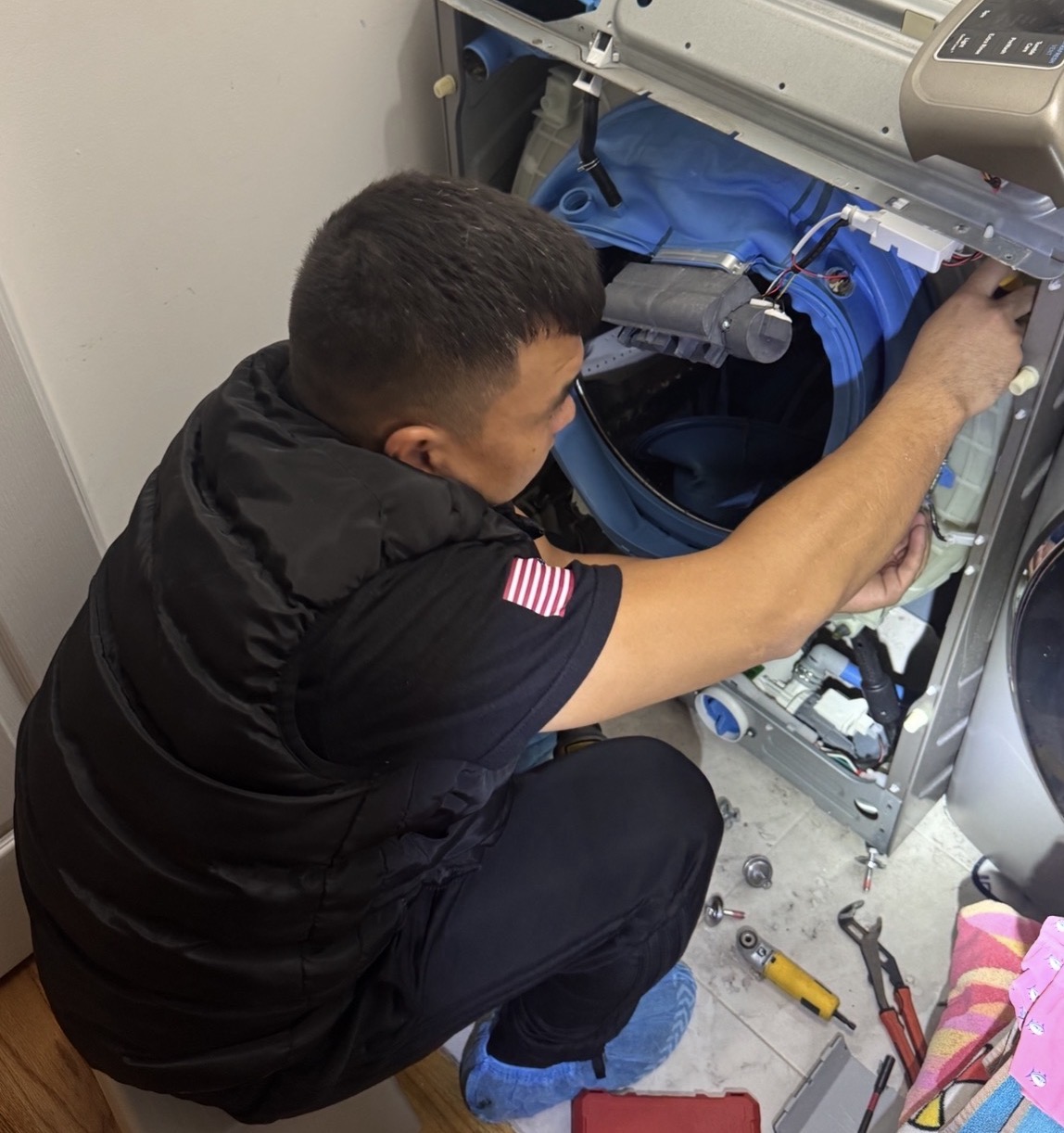
Badma arrives, inspects the range, and runs the test sequence specific to what you described. For "won't heat" — the igniter timing test through the oven window, then multimeter check of igniter current draw (healthy 2.5 to 3.6 amps; below ~2.7 amps the gas safety valve will not open). For repeat thermal fuse failures — measurement of rear-of-range ventilation clearance, sensor resistance check for drift, and door gasket inspection for asymmetric compression. For F1-E0 codes appearing in summer or after long bake cycles — thermal-stress assessment on the oven control board. For F5-E0 door switch faults — door hinge sag check (does the door stay at 90 degrees on its own?). This postwar-kitchen diagnostic checklist is the difference between a one-and-done repair and a recurring service call. The $80 covers the visit and full diagnosis regardless of how long it takes.
3
Written Quote — Exact Price Before Any Work
You get the exact repair price in writing: the specific Whirlpool, KitchenAid, Maytag, or Amana OEM part, its cost, and the labor. For 10306 postwar kitchens, we sometimes recommend replacing two or three related at-risk components together — for example bake igniter plus door gasket plus hinges on a 12-year-old unit reaching multiple end-of-life intervals simultaneously, or thermal fuse plus oven temperature sensor when sensor drift is the actual driver of the fuse failure. We always explain the reasoning before quoting it. If our diagnosis points at a structural cause (rear-of-range ventilation restriction driving recurring failures), we tell you so up front rather than quote parts that won't fix it. If you approve, the $80 diagnostic applies toward the total. If you decide to wait or get a second opinion, you pay only the $80 and Badma leaves. No pressure, no upsell.
4
Repair Done — Same Visit When Part Is On Truck
Most common Whirlpool gas oven parts ride on the truck for same-visit repair: bake igniters W10918546 and W11208965 (covering essentially every Whirlpool, KitchenAid, Maytag, and Amana gas range in 10306 households), oven thermal fuse WP9759242 (the part most-replaced after igniters in postwar kitchens because of thermal cycling pushing it toward its 130°C cutoff), oven temperature sensor WPW10181986, gas safety valve 98014893, door gasket W11542153, door lock motor and switch assembly WPW10107820, plus door hinge assemblies for sagging-door repairs common in original postwar geometry. Special-order parts — specific Smart-model display boards, certain wall-oven assemblies — are ordered and installed on a second visit, typically 1 to 3 business days. Every completed repair carries a 90-day parts and labor warranty backed directly by Premier Appliance Repair Staten Island LLC
90-Day Warranty
Serving New Dorp & Surrounding Postwar Mid-Island Neighborhoods
New Dorp — ZIP 10306
10306 covers the mid-island residential heart of Staten Island along the Hylan Boulevard corridor. New Dorp itself was developed earliest, with most of its housing built between 1945 and 1955 — Cape Cods, ranches, and split-levels along New Dorp Lane, Tysens Lane, and Hylan Boulevard. New Dorp Beach extends along the FDR Boardwalk south of South Beach. Oakwood expanded north of New Dorp through the late 1950s along Mill Road, Guyon Avenue, and Richmond Avenue. Midland Beach runs along the inland side of Father Capodanno Boulevard south of the South Beach line, with most homes built in the same postwar window. Grant City fills the corridor between New Dorp and the bay along the SIRT Grant City station. Most kitchens here are in homes built between 1945 and 1965 with original cabinet geometry largely intact even after multiple cosmetic renovations. The tight rear-of-range ventilation envelope these kitchens were built around — designed for 1955-era mechanical-timer ovens — drives a specific Whirlpool failure pattern in 10306 that doesn't appear in newer-construction ZIPs: thermal-stress aging on electronic control boards, recurring thermal fuse failures, and door hinge sag in original-geometry doors with limited swing clearance. The fix in many of those cases is structural rather than just a part replacement; we tell you which on every visit. Badma covers the full area same-day: Hylan Blvd, New Dorp Lane, Tysens Lane, Mill Rd, Guyon Ave, Richmond Ave, Father Capodanno Blvd, Midland Ave, Lincoln Ave, Olympia Blvd, Lamont Ave, Quintard St, and throughout New Dorp, Oakwood, Midland Beach, and Grant City.
New Dorp Oakwood Midland Beach Grant City New Dorp Beach Hylan Blvd New Dorp Lane Tysens Lane Mill Rd Guyon Ave Richmond Ave Lincoln Ave
Yes. Every completed repair has a $180 minimum labor charge, and your $80 diagnostic is applied toward it. We're a licensed, insured shop and back every repair with a 90-day parts-and-labor warranty - so even a quick fix gets the same workmanship and guarantee, not a temporary patch. If parts are needed, they're quoted on-site before any work, and nothing starts without your approval.
Why won't my Whirlpool oven heat in my New Dorp kitchen?+
On Whirlpool gas ovens (WFG and WEG series), the most common cause is a weakening bake igniter. The igniter still glows but no longer reaches the white-hot intensity needed to draw enough current to open the gas safety valve, so no gas reaches the burner. Test: set Bake 350°F and watch through the oven window — within 30 to 60 seconds you should see a bright glow at the bottom of the cavity, and the burner should ignite into a steady blue flame within 90 seconds total. Glow but no flame at the 90-second mark means weak igniter and replacement is needed (W10918546 on most current Whirlpool gas ranges; W11208965 on the newer WFG320 and WFG505 series). For 10306 specifically: many New Dorp, Oakwood, and Midland Beach homes are postwar Cape Cods and ranches with the original kitchen footprint largely intact, even after multiple cosmetic renovations. The tight rear-of-range ventilation envelope these kitchens were built with means modern Whirlpool electronic control boards run warmer than designed, which can shorten igniter and adjacent component service life by 1 to 2 years compared to newer-construction kitchens with proper rear airflow. We diagnose both standard igniter failure and thermal-stress patterns on every visit.
My Whirlpool oven keeps showing F1-E0 in my postwar Oakwood kitchen — is the control board the issue?+
F1-E0 indicates the oven control board cannot read its EEPROM calibration memory. F1-E1 is a checksum error on the same memory. In 10306 specifically, both codes are over-represented vs newer-construction ZIPs because postwar Cape Cods and ranches around Hylan Boulevard often have tight original cabinet geometry behind the range. Modern Whirlpool electronic boards rely on natural convection through the rear cavity for cooling; when the range sits in a 1955-design alcove with limited rear clearance, board temperatures climb during long bake cycles and the EEPROM and adjacent capacitors age years faster than spec. The pattern we see: F1-E0 starts appearing intermittently around year 8 to 10 in postwar-kitchen installations, vs year 12 to 15 in newer kitchens with proper ventilation behind the range. First diagnostic step is always a power cycle at the breaker for 5 to 10 minutes — clears transient EEPROM faults. If the code returns within hours or days, the board has hard-failed and replacement is the fix. Before quoting a control board, we measure the actual rear-cavity ventilation clearance and tell you whether airflow improvements (a simple ventilation gap behind the range) might extend the next board's life. Call (929) 261-4444.
My Whirlpool oven door doesn't close fully or sags — what's the fix?+
Sagging or improperly-closing oven doors are over-represented in 10306 vs other Staten Island ZIPs because postwar Cape Cod and ranch kitchen designs gave oven doors less swing clearance than modern designs assume. Years of moderate-frequency opening and closing in a tight kitchen layout where the door has to swing past adjacent cabinets, walls, or counter overhangs accelerate hinge spring fatigue. Symptoms: door drops below level when opened, requires lift-and-push to fully close, gasket seal compromised on one side, oven loses heat faster than it should, F5-E0 door switch faults appear because the control reads a partially-open door. Diagnosis: open the door fully, observe whether it stays at 90 degrees on its own or sags below horizontal. Sag = hinge springs fatigued. Inspect the perimeter gasket (W11542153) for asymmetric compression — flatter on the side where the door has been sagging. The fix is door hinge replacement plus often the gasket on units 8+ years old. Both same-visit on most Whirlpool, KitchenAid, Maytag, and Amana platforms. If your range has been in the same New Dorp kitchen footprint for 15+ years, mention it on the call — we will bring the matching hinge assembly and gasket. Call (929) 261-4444.
Why does my Whirlpool oven thermal fuse keep blowing in my Midland Beach kitchen?+
Whirlpool oven thermal fuses (WP9759242 covers most current units) are 130°C single-use safety devices that open the oven heating circuit if cavity wall temperature exceeds the cutoff. They are designed to operate near but not at their cutoff during normal cooking. Repeat thermal fuse failures are not random — they signal something pushing temperatures higher than spec. In 10306 postwar kitchens we see three drivers. First, restricted rear ventilation behind the range traps heat against the cabinet, which radiates back through the rear cavity wall and pushes the fuse closer to its threshold. Second, an aging oven temperature sensor reading slightly low causes the control to overshoot set temperature on each cycle, again pushing the fuse closer to cutoff. Third, a worn door gasket lets cavity heat escape into the front control area where the fuse sometimes lives, paradoxically heating the fuse from outside the cavity. Replacement fuse alone without addressing the underlying thermal driver means another fuse failure within months. We diagnose all three on the same visit and explain which is the actual root cause before quoting parts. Call (929) 261-4444.
The igniter on my Whirlpool oven glows but the burner never lights. What's wrong?+
This is the single most common Whirlpool gas oven failure on units 6 to 10 years old, and it almost always means the igniter has lost pulling power. The igniter does two jobs simultaneously: it heats white-hot to ignite gas at the burner, and it acts as a current sensor that tells the gas safety valve when to open. As the igniter ages, its resistance climbs, the current it draws drops, and the safety valve never receives the threshold signal to release gas — so you see the glow without the flame. Replacing the gas safety valve (98014893) is rarely the right fix; replacing the igniter almost always solves it. Multimeter test for technicians: a healthy Whirlpool hot-surface igniter draws between 2.5 and 3.6 amps. Below approximately 2.7 amps, the safety valve will not open. The current-generation Whirlpool igniter is W10918546 — fits most WFG and WEG models. The newer WFG320 and WFG505 series uses W11208965. Badma carries both on the truck. We see this failure mode often across New Dorp, Oakwood, Midland Beach, and Grant City — where Whirlpool gas ranges 8 to 12 years old are common in long-tenure households along the Hylan Boulevard corridor. Call (929) 261-4444.
How much does Whirlpool oven repair cost in New Dorp?+
The diagnostic is $80 flat — covers the trip to your New Dorp, Oakwood, Midland Beach, Grant City, or anywhere along the Hylan Boulevard corridor address, full on-site diagnosis, and a written quote. After diagnosis, the repair price depends on which part failed and your specific Whirlpool model. We don't guess over the phone because two ovens with the same won't-heat symptom can need different parts — a bake igniter, a temperature sensor, a thermal fuse, or a control board are all different repairs at different prices. In 10306 specifically, thermal fuses (WP9759242) and oven control boards become more frequent repairs than in newer-construction ZIPs because of the tight-kitchen heat-management pattern. Whirlpool igniters and sensors are mid-priced repairs. Door hinges (the second-most-replaced part in postwar 10306 kitchens) and door gaskets sit in a similar range. Oven control boards are higher. You get the exact number in writing before any work starts. If you approve, the $80 applies toward the total.
I smell gas near my Whirlpool range — what should I do first?+
Do NOT try to fix this yourself. Turn the range OFF at all knobs. Open windows for ventilation. Do not flip light switches, do not use lighters or matches, do not plug or unplug anything — a single spark can ignite accumulated gas. Call National Grid's 24-hour gas emergency line at 1-718-643-4050. They respond free of charge anywhere on Staten Island and will shut off the gas supply at the meter if there is a confirmed leak. Only after National Grid clears the situation and the area is safe, call us at (929) 261-4444 to repair the range part that caused the issue. We do not service live gas leaks — that is utility-company work. Once the gas is verified safe, we fix the appliance. In 10306 postwar kitchens specifically, gas line connectors at the back of the range have sometimes been moved or extended during multiple decades of kitchen renovations — worth mentioning to National Grid if the smell is at the connection rather than the burner.
Do you service all of New Dorp, Oakwood, Midland Beach, and Grant City?+
Yes — the full 10306 ZIP. New Dorp along Hylan Boulevard, New Dorp Lane, and Tysens Lane; the historic New Dorp Beach area along the FDR Boardwalk south extension. Oakwood north of New Dorp toward Richmond Avenue, along Guyon Avenue and Mill Road. Midland Beach along Father Capodanno Boulevard south of the South Beach line and inland through Midland Avenue. Grant City along the SIRT Grant City station corridor and Lincoln Avenue. Same diagnostic price and same warranty regardless of where in 10306 you are. Same-day service 7 days a week: Mon–Fri 8 AM – 10 PM · Sat–Sun 9 AM – 5 PM.
What Whirlpool models do you repair?+
Every Whirlpool gas range, slide-in, freestanding, and wall oven, plus the KitchenAid, Maytag, and Amana sister brands that share the Whirlpool platform. Common gas models in 10306 postwar kitchens: WFG320M0BS, WFG505M0BS, WFG525S0HS, WFG535S0LS, WFG540, WEG745H0FS, WEG750H0HZ, WFG775H0HZ, WFG975H0HZ. Whirlpool gas wall ovens (often retrofitted into the original built-in space): WOS51EC0HS, WOS51EC0HW, WOD51EC0HS, WOD77EC0HS, WOSA2EC0HZ. KitchenAid sister-brand gas: KFGG500ESS, KFGS500ESS, KSGB900ESS. Maytag and Amana gas ranges built by Whirlpool fit the same igniter (W10918546 or W11208965 depending on the production series), the same oven sensor (WPW10181986), the same thermal fuse (WP9759242), and the same door gasket (W11542153). If you have a different Whirlpool gas model, call with the model number from the label inside the door frame and we will tell you which igniter generation and which oven sensor your unit takes.
How long is the warranty?+
Every completed repair carries a 90-day parts and labor warranty. If the same issue returns within 90 days, Badma comes back and fixes it at no additional charge. The warranty is backed directly by Premier Appliance Repair Staten Island LLC — no paperwork to file with a third party. The $80 diagnostic itself is not warranted (it covers the on-site visit and inspection), but every repair we perform is. For 10306 specifically: in postwar kitchens where the underlying tight-cabinet thermal environment drives recurring failures (thermal fuse blown, control board aging) we sometimes recommend replacing two related parts together rather than one — and we explain why on-site so you can decide. When ventilation behind the range is the actual root cause of repeated failures, we say so before quoting parts that won't fix the structural issue.
Ready to Fix It
Whirlpool Gas Oven Down in New Dorp? Try the DIY Steps First — Then Call Us
Same-day service across ZIP 10306. $80 diagnostic, exact repair price after we see the problem, 90-day warranty on every completed repair.