Won't heat · Igniter glows but no flame · Slow preheat · Burner won't light · F1-E0 EEPROM · F9 outlet · PF after a flicker — same-day Whirlpool gas range and oven repair in Silver Lake, Grymes Hill, Tompkinsville & West Brighton
$80 diagnostic · Exact repair price after diagnosis · 90-day warranty
GET A CALLBACK
Describe the problem — Badma will call to confirm the likely fix and same-day availability in Silver Lake, Grymes Hill, Tompkinsville, or West Brighton.
Whirlpool Gas Oven Repair — Silver Lake 10301
"My Whirlpool oven won't heat." "The clock keeps resetting and I see PF every morning." "F1-E0 came up after the storm last week — it cleared, but now it's back." "We renovated the kitchen and now the display flickers and shows F9." Four calls dominate every week of Whirlpool oven service in Silver Lake, Grymes Hill, Tompkinsville, West Brighton, and St. George. There's a single root cause behind a surprisingly large share of them, and it has very little to do with the oven itself. We will explain it below — and tell you what's actually solvable in 5 minutes versus what needs Badma's truck on your address.
If the simple checks don't fix it, that's when you call us. Premier Appliance Repair Staten Island charges a flat $80 diagnostic to come anywhere in 10301 — whether you are up the slope on Grymes Hill near Wagner College, in a brick row house off Victory Boulevard in Tompkinsville, in a wood-frame on the West Brighton side of Forest Avenue, or near the courthouse in St. George. Badma diagnoses on-site and gives you the exact repair price in writing before any tool comes out of the bag. If you approve, the $80 applies toward the repair. If you don't, you pay only the $80. Importantly: when our diagnosis points to electrical wiring outside the oven (a recurring F9, a PF loop, voltage sag tripping the control board), we tell you so up front and don't quote you appliance work that won't fix the actual problem.
Safety first — gas smell is not a DIY situation. If you smell gas (and not just a brief whiff when a burner first lights), turn off the range, open windows, do not flip any light switches, and call National Grid at 1-718-643-4050. They respond 24/7 free of charge and will shut off the supply if there's a leak. Only after the gas situation is verified safe, call us.
10301 is one of the oldest residential ZIPs on Staten Island. Silver Lake reservoir was built in 1917; most of the surrounding housing went up between the 1920s and 1940s — pre-war wood-frames around Silver Lake Park, hillside two-families up Grymes Hill past Wagner College, attached row houses along Tompkinsville's Victory Boulevard corridor, brick singles and Victorians on the West Brighton side toward Snug Harbor. A lot of these homes still run on legacy electrical service: original 60-amp main panels, long aluminum branch runs, ungrounded two-wire kitchen receptacles, and aging neutral connections at the panel that never got upgraded when the kitchen got its last cosmetic renovation.
Older mechanical-timer ovens did not care about any of that. A wall thermostat and a relay don't notice a 5-volt dip when the refrigerator compressor kicks on. Whirlpool's modern electronic control boards do care. They expect a clean, steady 120V supply. When voltage at the outlet sags below the board's brown-out threshold — even for a fraction of a second — the board reboots. On reboot, the EEPROM (the memory chip that stores calibration and settings) sometimes can't be read cleanly on the first attempt, and the board throws an F1-E0 communication error or an F1-E1 checksum error. Sometimes the board simply restarts and shows PF (power-failure recovery). Other times — especially after a recent installation, electrical work, or a kitchen renovation that disturbed legacy wiring — it throws F9, indicating a miswired outlet, missing neutral, or polarity issue.
The pattern we see in 10301: residents call about F-codes that nobody can explain because the oven was working fine yesterday. There was no thunderstorm, no obvious outage. But there was a brief brownout that nobody noticed, triggered by something else in the house starting up — central AC, well pump, dehumidifier, even a high-draw vacuum on the same circuit. The fix in those cases is not a $400 control board. It's an electrician inspecting the receptacle, the breaker, and the neutral connection. We tell you which side of the line the problem is on at the standard $80 visit.
Before assuming the Whirlpool control board has failed, run this sequence. It is free and takes about 5 minutes, and it tells us — and you — whether the next step is an appliance technician or an electrician.
1. Check the breaker for a "half-trip." A half-tripped breaker looks ON but isn't carrying full load. Find the panel breaker labeled "Range," "Kitchen," or "Oven." Push it firmly all the way to OFF (you may feel a click), wait 30 seconds, then push firmly all the way to ON. This catches half-trips that visual inspection misses.
2. Confirm the receptacle behind the range is gripping the plug. Pull the range straight out from the wall (carefully — gas line is flexible but limited), unplug, inspect the plug blades for darkening or burn marks (a sign of arcing, which means the receptacle has loosened over the years), then firmly reinsert. In pre-war 10301 homes, range receptacles can be 30+ years old and have lost spring tension on their internal contacts. A loose receptacle causes intermittent voltage drop that the Whirlpool control board reads as a brown-out.
3. Test for the obvious culprit. Plug a lamp or phone charger into the same outlet (after the range is back on its own outlet, of course) and watch what happens when the refrigerator compressor cycles on, or when central AC starts. If the lamp visibly dims, you have voltage sag on that branch — and that is what is rebooting your oven. This finding alone justifies an electrician visit before any oven parts are ordered.
4. Long power cycle. Some Whirlpool F1-E0 codes respond well to a 5-to-10-minute breaker reset (longer than the usual 30 seconds). After power returns, wait at least 1 minute before pressing any button so the boards finish their boot sequence. Pressing a button within 10 seconds of breaker recovery can also momentarily trigger an F9 code on its own — wait the full 10.
If steps 1–4 don't fix it, that's when we come out and run the appliance-side diagnosis.
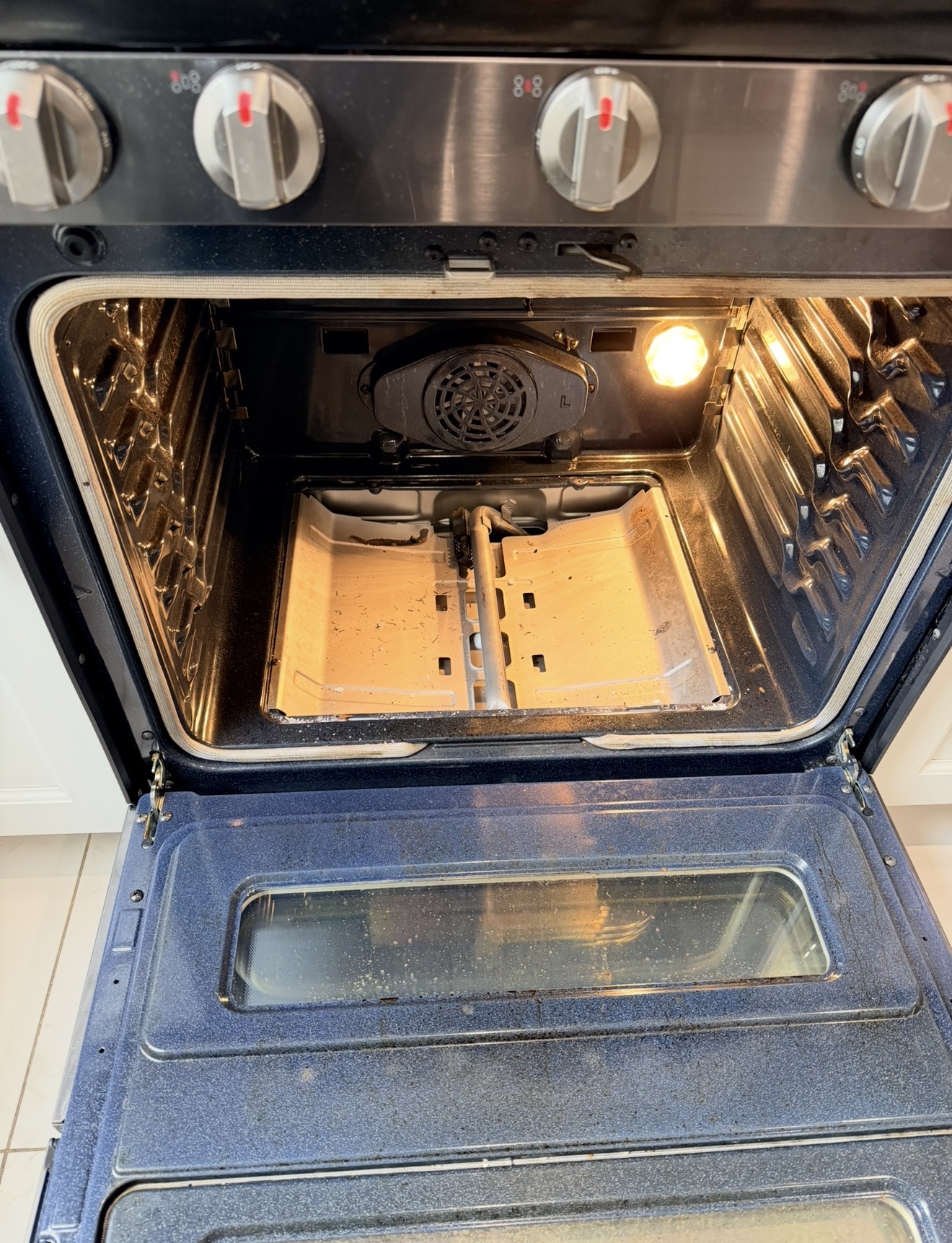
If the display is alive and the controls respond but the oven simply doesn't heat — that is a different fault from the F-code reset family above, and the diagnosis lives on the gas side. The most common Whirlpool gas oven failure on units 6 to 10 years old, regardless of ZIP, is a weakening bake igniter. Set the oven to Bake 350°F with the oven light on, close the door, and watch through the window with a phone timer running. The sequence you're looking for: within roughly 30 to 60 seconds, a bright glow at the bottom of the oven cavity — the igniter ramping from red through orange toward white-hot. By around the 1-minute mark, you should hear the gas safety valve open with a soft click, and the burner should ignite into a steady blue flame within 90 seconds total from the moment Start was pressed. If 90 seconds pass with the igniter glowing but no flame appears, industry repair guidance is consistent: the igniter is no longer drawing the threshold current the safety valve needs, and replacement is the fix.
The reason this matters mechanically: the Whirlpool gas oven igniter does two jobs simultaneously. It heats the gas to ignition temperature, and it acts as a current sensor that tells the gas safety valve when to open. As the igniter ages, its silicon-carbide element develops microcracks, its resistance climbs, the current it pulls drops, and at some point the safety valve no longer receives the threshold signal — so you get a glowing igniter with no flame. Multimeter spec for technicians: a healthy Whirlpool hot-surface oven igniter draws between 2.5 and 3.6 amps under load. Below approximately 2.7 amps, the safety valve will not open. Below 2.0 amps, the igniter is fully spent. Resistance check at room temperature reads roughly 80 to 175 ohms on a healthy igniter; an open-circuit reading (infinite ohms) means the element is broken and the igniter is fully dead. The current-generation Whirlpool oven igniter is W10918546 and fits most WFG and WEG gas ranges in current circulation — including WFG320M0BS, WFG505M0BS, WFG525S0HS, WFG535S0LS, WFG540, WEG745H0FS, WEG750H0HZ, WFG775H0HZ, and WFG975H0HZ. The newer WFG320 and WFG505 production series uses W11208965. Both fit most KitchenAid (KFGG500ESS, KFGS500ESS, KSGB900ESS), Maytag, and Amana gas ranges built by Whirlpool — sister brands on the same Whirlpool platform.
What "weak igniter" actually looks like through the oven window — the visible gradient most homeowners can read without a meter: the glow stops at red and never advances = igniter is far gone. The glow climbs to orange but never reaches white-hot = igniter is failing, will give out within weeks. The glow climbs to orange-white and the burner lights = igniter is healthy. Color is a useful but imperfect signal; timing is the better test. Glow showing up only after 60+ seconds, or burner not lighting until 90+ seconds, is independent confirmation regardless of color.
PF is Power Failure recovery. The oven detected a brief interruption to its power supply and is reminding you to reset the clock. A single PF after a thunderstorm, a confirmed Con Edison outage, or a planned panel maintenance is normal — press Cancel, reset the time, move on. The problem is when PF appears repeatedly with no obvious outage. That is the 10301 signature. We see it most often in homes where the kitchen is on a circuit that shares with high-draw appliances elsewhere in the house — central AC compressor, electric dryer, well pump in some West Brighton homes. The voltage sag when those start up is enough to reboot the oven board. PF reappears every time. Until the wiring is corrected, the oven is fine but the experience is broken.
F9 is the most misunderstood Whirlpool oven code. It is not a door lock fault — that is the F5 family. F9 means electrical wiring at the outlet, the connection to the oven, or the line itself is wrong. Most often: a missing or weak neutral, reversed polarity, or a downstream connection that an electrician got close-but-wrong during a kitchen renovation. We see F9 most often in 10301 in two scenarios: 1) recently renovated kitchens in older homes where modern grounded receptacles got installed onto two-wire legacy wiring without proper bonding; and 2) range outlets that were "updated" by a previous homeowner using DIY methods. Press Cancel; if F9 returns immediately, do not run the oven. We diagnose the appliance side at the standard $80 visit and confirm whether the appliance itself is contributing — but the fix is electrical and needs a licensed electrician for the wiring repair.
Different from "won't heat." If the display is completely dark, no lights, no beep when buttons are pressed, the focus is power supply.
Step 1: Confirm the breaker — full ON cycle as described above.
Step 2: Reseat the wall plug. In pre-war 10301 homes, range receptacles often have decades of vibration loosening — push the range out and verify the plug is fully seated and the receptacle isn't burnt.
Step 3: Power cycle for a full 5 to 10 minutes — sometimes the control board is stuck in a low-power state and a long cycle clears it.
If the display still won't power up, the touch control board, the oven relay control, the ribbon cable between them, or in rare cases the internal power supply has failed. We diagnose on-site and tell you which board, before quoting any parts.
If the oven heats but takes 25–30 minutes to reach 350°F, or food isn't cooking right:
(1) Weak bake igniter on gas models. Even when it lights the burner, a weak igniter cycles the gas valve open later and shorter than designed — so preheat is slow. Run the glow test above.
(2) Door gasket compressed or torn. Open the door and inspect the gasket (W11542153 on most current models) around the oven opening. If it's flattened, ripped, or missing in spots, heat is escaping. Same-visit replacement.
(3) Drifting temperature sensor. The oven shuts off heat early on a misleading reading. Buy a $6 oven thermometer at any Staten Island hardware store, set the oven to 350°F, wait 20 minutes, and compare actual to displayed. Off by more than 35°F means the sensor (WPW10181986) has drifted and needs replacement.
Different from oven issues — this is the cooktop. Almost always a cleaning fix, not a parts repair. Let the burner cool fully. Lift off the grate, the burner cap (round black piece on top), and the burner head (metal piece with holes around its edge). Clean the small holes with a pin or toothpick — trapped food and grease block gas flow. Wash with warm soapy water, rinse, and dry completely — moisture in the burner is the second most common cause of click-but-no-light. Reassemble with the cap flat and centered on the head, not tilted. If the burner still clicks without lighting after cleaning, the spark electrode (small ceramic piece next to the burner) is cracked or worn from years of cleaning, or the spark module behind the panel has weakened. Standard parts, same-visit replacement.
A lot of shops quote a price on the phone and change it when they arrive. We don't. Two Whirlpool ovens with "won't heat" can need different parts: a weak igniter, a drifting sensor, a thermal fuse blown by a self-clean cycle, a gas safety valve, or a relay on the oven control board. The only way to know is to test on-site. You pay $80 for the diagnosis. You get the exact repair price in writing. You decide whether to proceed. If yes, the $80 is credited toward the repair. If no, you pay only the $80 and we leave. Same deal for every customer in Silver Lake, Grymes Hill, Tompkinsville, West Brighton, and St. George.
If you've ruled out PF, F1-E0, and the wall outlet, and the oven simply doesn't heat, the next-most-likely cause in 10301 by a wide margin is the bake igniter. Whirlpool gas oven igniters are consumable parts — they last roughly 7 to 10 years of normal household use before they degrade past the point where the gas safety valve will open. In 10301 specifically, where Whirlpool gas ranges 8 to 12 years old are common in long-tenure households across Silver Lake, Grymes Hill, and West Brighton, igniter failure is the single most-called repair we run. Below are the symptoms ranked by how telling each one is.
Strongest sign — glow but no flame. The bottom of the oven shows a clear orange-to-white glow when you set Bake 350°F, but no blue flame ever appears at the burner, even after a full minute of glowing. The igniter is heating, but its resistance has climbed too high to draw the threshold current (about 2.7 amps) the gas safety valve requires to open. No gas flows; no flame. This is the classic weak-igniter signature.
Strong sign — slow preheat that has gradually gotten slower. Whirlpool gas ovens should hit 350°F in 10 to 13 minutes from cold. If yours used to preheat in 12 minutes and now takes 25 to 30, and the slowdown happened gradually over months, the igniter is on its way out. Even when it eventually opens the safety valve, a weak igniter cycles the gas open later in each cycle and shorter, so the burner runs less than it should.
Strong sign — oven only lights when a stovetop burner is on first. A surprisingly common 10301 search query: "Whirlpool gas oven only works when stove top burner is on." When a stovetop burner ignites, it draws current that pulls the line voltage at the oven igniter circuit slightly differently — sometimes just enough to push a borderline-weak igniter over the threshold the safety valve needs. If your oven only lights when a cooktop burner is on, the igniter is failing.
Moderate sign — orange glow that never reaches white-hot. A healthy Whirlpool oven igniter ramps red, orange, and finally white-hot. If you watch through the oven window and the glow stops at red or orange and never brightens further, the igniter has aged. It might still light the burner most of the time today; it almost certainly won't a few months from now.
Moderate sign — clicking sound but no glow. Different mechanism, but worth distinguishing: clicking with no glow usually means the spark module on the cooktop side is doing what it's supposed to but the oven igniter circuit itself has gone open. That's a wiring break or a fully dead igniter, not a weak one.
The current Whirlpool oven igniter is W10918546, used on the majority of WFG and WEG gas ranges in current circulation — including WFG320M0BS, WFG505M0BS, WFG525S0HS, WFG535S0LS, WEG745H0FS, WEG750H0HZ, WFG775H0HZ, and WFG975H0HZ. The newer WFG320 and WFG505 production series uses W11208965. Both igniters get carried on the truck so 10301 households who watched the bake igniter glow without seeing a flame can have their oven heating again the same visit. The same igniter parts also fit KitchenAid (KFGG500ESS, KFGS500ESS, KSGB900ESS), and most Maytag and Amana gas ranges built by Whirlpool — sister brands all run on the same Whirlpool platform.
One of the most common diagnostic mistakes — both DIY and from less-experienced techs — is to chase the gas safety valve when the symptom is glow-but-no-flame. The reasoning sounds right: "the gas isn't reaching the burner, so the valve must be bad." It almost never is. The gas safety valve in a Whirlpool gas oven is electrically simple — a solenoid that opens when it sees enough current through the igniter circuit. Valves rarely fail; igniters routinely degrade. When the igniter ages, its resistance climbs and the current drops below the valve's threshold. The valve is doing exactly what it should — refusing to open without confirmation that something hot is waiting to ignite the gas. Replacing the gas safety valve (98014893) on a glow-but-no-flame symptom replaces a working part. The actual fix is the igniter.
If your Whirlpool gas oven is built into the wall rather than a freestanding range — common in 10301 in renovated kitchens where the cooktop is separate — the diagnosis is the same. WOS51EC0HS, WOS51EC0HW (single wall ovens), WOD51EC0HS, WOD77EC0HS (double wall ovens), and the WOSA2EC0HZ Smart wall oven all use the same Whirlpool oven platform with bake igniter and oven temperature sensor in the same locations. The only practical difference: wall ovens take longer to remove and reinstall for access, so the visit can run longer than a freestanding-range repair. Same parts, same diagnostic, same 90-day warranty.
Whirlpool also builds a small electric range line (WFE / WEE series), and we do see them occasionally in upper-floor apartments around Tompkinsville and St. George where the gas line wasn't extended. Same diagnostic process; the failure mode shifts to bake elements rather than igniters.
Whirlpool Corporation has owned KitchenAid since 1986, Maytag and its sister brands (Amana, Magic Chef, Jenn-Air) since 2006. From a service standpoint, that means the parts on a KitchenAid KFGG500ESS gas range, a Maytag freestanding, or an Amana wall oven are largely the same as on the equivalent Whirlpool — same igniters (W10918546, W11208965), same temperature sensors (WPW10181986), same door lock motors (WPW10107820), often built on the same factory line in Cleveland, Tennessee or Findlay, Ohio. We service all four sister brands at the standard $80 diagnostic. Bring the model number from the door frame label and we tell you which Whirlpool platform underlies it.
Why Choose Premier
| Factor | 🏢 Whirlpool Service | 🔧 Premier Appliance |
|---|---|---|
| Arrival in Silver Lake | ❌ 5–14 day wait | ✅ Same-day |
| Free phone advice before a visit | ❌ Queue & script | ✓ Always |
| Diagnostic fee | ❌ $100–150+ | ✅ $80, applied |
| Price quoted before work starts | ❌ Not always | ✅ Always in writing |
| Warranty | ❌ Varies | ✅ 90-day guarantee |
| Weekend availability | ❌ Weekdays only | ✅ Mon–Sun |
Honest, Transparent Pricing
Prices subject to NY state sales tax (8.875%).
Book Your Visit
Same-day diagnosis — $80 flat, exact repair price after we see the problem. Badma covers Victory Blvd, Forest Ave, Castleton Ave, and all of ZIP 10301.
📅 Book Online Now 📞 (929) 261-4444Whirlpool Oven Error Codes & Display Diagnostics
Pre-war Silver Lake, Grymes Hill, and West Brighton homes run Whirlpool electronic-control ovens on legacy electrical service. That shifts which F-codes appear most. Power-and-control codes (F1-E0, F1-E1, F9, PF) are over-represented here vs. South Shore ZIPs. Door and lock codes are similar; igniter and sensor codes track baseline.
The single most-called Whirlpool gas oven repair in 10301 doesn't show an F-code at all. The oven controls work, the display is normal, the cooktop burners light fine — but the oven itself stays cold. Display lit, no error. The cause is almost always a weakening bake igniter, and the test takes 90 seconds and a phone timer.
Whirlpool oven igniter W10918546 covers most current Whirlpool gas ranges (WFG320M0BS, WFG505M0BS, WFG525S0HS, WFG535S0LS, WFG540, WEG745H0FS, WEG750H0HZ, WFG775H0HZ, WFG975H0HZ); W11208965 fits the newer WFG320 and WFG505 production series. Both ride on the truck. Multimeter spec for the curious: a healthy igniter draws 2.5 to 3.6 amps under load; below ~2.7 amps the safety valve will not open. Resistance check at room temperature reads 80 to 175 ohms healthy. Call (929) 261-4444 →
F1-E0 indicates the oven control board cannot read its EEPROM calibration memory. F1-E1 is a checksum error on the same memory. In 10301 specifically, both codes are over-represented compared to newer Staten Island ZIPs because pre-war Silver Lake, Grymes Hill, and West Brighton homes often have legacy electrical service that delivers 120V with periodic voltage sag — and Whirlpool's electronic control board was designed for clean steady supply.
Power-quality diagnosis is included in the standard $80 visit. Call (929) 261-4444 →
PF means the oven detected a brief interruption to its power supply. A single PF after a confirmed outage is normal — press Cancel, reset the clock. The 10301 problem is when PF appears repeatedly with no obvious outage. The cause is almost always voltage sag on a pre-war kitchen circuit when something high-draw elsewhere in the house starts up.
We diagnose which side of the line the issue is on at the standard $80 visit. Call (929) 261-4444 →
F9 is the most misunderstood Whirlpool oven code. It is not a door lock fault (that is the F5 family). F9 indicates an electrical wiring issue at the outlet, the connection to the appliance, or the line itself: a missing neutral, reversed polarity, or a downstream connection error from a recent electrician visit, kitchen renovation, or DIY upgrade.
F9 is significantly more common in 10301 than in newer Staten Island construction because of the prevalence of original two-wire receptacles and DIY electrical upgrades in pre-war homes. We diagnose the appliance side at the standard $80 visit and confirm the cause is wiring, not the oven, before any electrician visit. Call (929) 261-4444 →
F3-E0 means the sensor circuit is open — broken wire, disconnected harness, or sensor that has failed open. F3-E1 means the sensor or its wiring has shorted. Either way, the control board can no longer read oven temperature accurately and shuts off heat to prevent unsafe operation. In older 10301 installations we sometimes find the wire harness connector behind the cavity has fatigued from decades of thermal cycling, even though the sensor itself is fine.
Sensor (WPW10181986) is the standard fix; on a small fraction of older 10301 installations the wire harness needs re-pinning or replacement. Call (929) 261-4444 →
This is a safety code, not a sensor fault. A bare F2 means oven temperature climbed beyond the safe upper limit and the control's runaway protection has activated. Stop using the oven and turn off the breaker until inspected. Industry repair guidance: check for welded contacts on the bake and broil relays first; if any are welded, the oven control board has to be replaced.
Same-day matters here for safety. Call (929) 261-4444 →
F2-E0 means the control reads a button as continuously pressed when nothing is being pressed — almost always food splatter, grease film, or moisture on the panel. F2-E1 means the touch panel cable has lost connection to the control board.
Whirlpool touch panels are generally reliable but moisture and grease build-up cause issues over time. Call (929) 261-4444 →
The F5 family covers the door circuit. F5-E0 means the door switch has failed or its wiring broke. F5-E1 means a self-clean cycle started but the control didn't see the door reach fully closed before locking. F5-E2 means the door lock motor failed to engage during a self-clean attempt.
Fix is usually the door lock motor (WPW10107820) or door switch. Same-visit replacement. Call (929) 261-4444 →
The oven simply doesn't heat (or doesn't turn on at all) and no error code points to a cause. In 10301 this is usually one of four things.
If none of these apply, the silent failure is usually an igniter or sensor gone fully open-circuit, or a control board that boots into a stuck state. Call (929) 261-4444 →
Common Whirlpool Oven Problems — Silver Lake 10301
The most common Whirlpool gas oven complaint on units 6 to 10 years old. The cause in the vast majority of cases is a weakening bake igniter. Run this test before calling:
Bake igniter is W10918546 on most current Whirlpool gas ranges or W11208965 on the newer WFG320/WFG505 series — Badma carries both on the truck. Call (929) 261-4444 →
Different from "won't heat" — here the display itself is dead. In pre-war 10301 homes this is power-related more often than parts-related, and the diagnostic sequence reflects that.
If steps 1–4 don't restore power, the touch control board, oven relay control, ribbon cable, or internal power supply has failed. We diagnose which on-site. Call (929) 261-4444 →
This is a 10301 signature problem. PF is Whirlpool's power-failure recovery code — the oven detected a brief power interruption and is reminding you to reset the clock. A single PF after a confirmed outage is normal. The problem is when PF appears repeatedly, sometimes daily, with no obvious outage.
The reason PF is more common in pre-war 10301 homes than in newer Staten Island construction is straightforward: legacy electrical service (60-amp panels, ungrounded 2-wire receptacles, long aluminum branch runs, aging neutrals) doesn't deliver the steady 120V that Whirlpool's electronic control boards expect. We diagnose which side of the line — appliance or wiring — at the standard $80 visit and tell you who to call next. Call (929) 261-4444 →
F1-E0 indicates the oven control board cannot read its EEPROM calibration memory. F1-E1 indicates a checksum error on the same memory. Both can clear themselves after a long power cycle if the trigger was a transient brownout, or persist if the EEPROM has corrupted.
This kind of pre-diagnostic check is the difference between a one-and-done repair and a recurring service call. Especially important in pre-war 10301 homes where legacy electrical service interacts badly with electronic control boards. Call (929) 261-4444 →
If the oven heats but takes 25+ minutes to reach 350°F, or food consistently undercooks or burns, three causes account for nearly all of these calls:
Badma tests sensor, igniter, and gasket on diagnosis to identify which is the real cause. Call (929) 261-4444 →
This is a safety situation — do not try to DIY it. A brief gas smell when a burner first lights is normal. A persistent gas smell when the range is off is not.
We don't service live gas leaks — that's utility-company work. But once the gas is off and safe, we repair the range part that caused it. Call after the gas situation is safe →
A diagnostic-grade clue most homeowners don't realize they're seeing: the oven only fires the burner when one of the cooktop burners is already lit. Search any version of "Whirlpool gas oven won't heat unless stove top burner is on" and you'll find dozens of forum posts. The mechanism is straightforward — a stovetop burner draws a small additional current through the same circuit, which can be just enough to push a borderline-weak bake igniter past the threshold the gas safety valve needs to open.
This symptom catches a degrading igniter early. Catch it now and the oven keeps working through the holidays; ignore it and the oven will fail completely within a few weeks. Call (929) 261-4444 →
Different from "won't heat at all." Here the oven heats some, the display climbs, but it never actually reaches the set temperature. Two main causes:
Badma checks both with a multimeter test on the sensor and a current-draw test on the igniter — same visit. Call (929) 261-4444 →
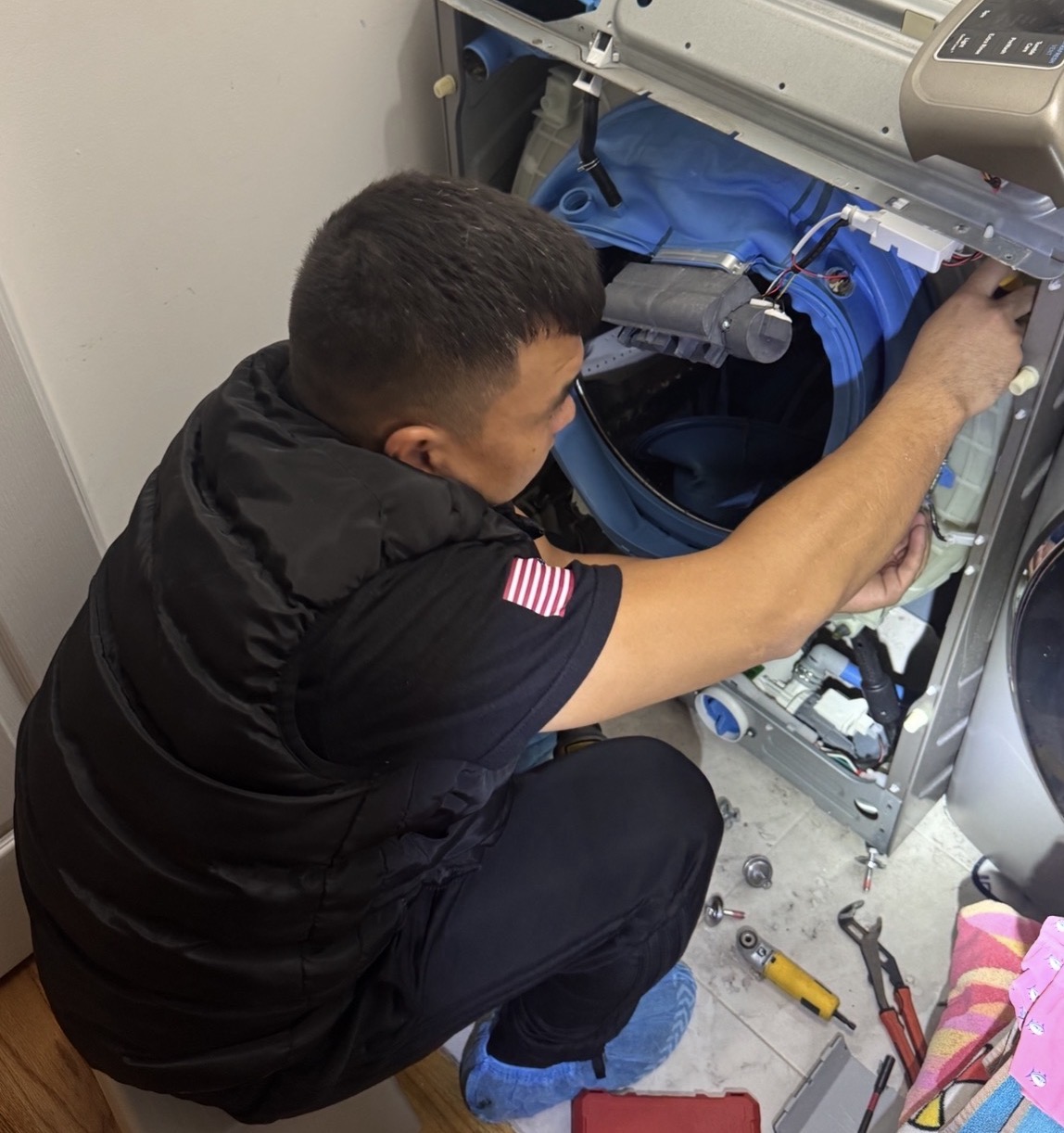
Your Technician
The Repair Process
Call (929) 261-4444 or book online. Have two things ready: the Whirlpool model number from the label inside the door frame (it starts with WFG, WEG, WFE, WEE, WOS, WOD, or one of the sister brands KFGG, KFEG, MGR, AGR), and what you're actually seeing — the F-code on display, whether the igniter glows, whether self-clean was running when it failed, whether PF appears after a flicker. The model tells Badma which igniter to load (W10918546 for most units, W11208965 for the newer WFG320/WFG505 series). Some 10301-typical issues — Sabbath mode stuck on, single PF after a confirmed outage, F9 right after a kitchen renovation — get solved over the phone in 5 minutes at no cost.
📅 7 Days a WeekBadma arrives, inspects the range, and runs the test sequence specific to what you described. For "won't heat" — the igniter timing test through the oven window, then a multimeter check of igniter current draw (healthy 2.5 to 3.6 amps; below ~2.7 amps the gas safety valve will not open). For F3 codes — sensor resistance verified against spec at room temperature. For F1-E0, PF, or F9 — line voltage measured at the outlet under load to identify whether the trigger is appliance-side or wiring-side. This last check matters specifically in 10301: replacing a control board on a circuit that still has voltage sag means the new board fails on the same fault. The $80 covers the visit, full diagnosis, and the power-quality pre-check regardless of how long it takes.
You get the exact repair price in writing: the specific Whirlpool OEM part, its cost, and the labor. If our diagnosis points to wiring outside the appliance — recurring F9 from a miswired outlet, voltage sag triggering F1-E0 — we tell you so up front and don't quote you appliance work that won't fix the actual problem. If you approve the appliance repair, the $80 diagnostic applies toward the total. If you decide to wait or get a second opinion, you pay only the $80 and Badma leaves. No pressure, no upsell.
Most common Whirlpool gas oven parts ride on the truck for same-visit repair: bake igniters W10918546 and W11208965 (the two igniter generations that cover essentially every Whirlpool gas range in 10301 households), oven temperature sensor WPW10181986, oven thermal fuse WP9759242, gas safety valve 98014893, door gasket W11542153, door lock motor and switch assembly WPW10107820. The igniter is the part replaced most frequently in 10301 — typical bake igniter glow test that ends with no flame, glow that never reaches white-hot, or oven only firing when a stovetop burner is already on, gets the igniter swapped in roughly 30 minutes start-to-finish. Special-order parts — specific Smart-model display boards, certain wall-oven assemblies — are ordered and installed on a second visit, typically 1 to 3 business days. Every completed repair carries a 90-day parts and labor warranty backed directly by Premier Appliance Repair Staten Island LLC
🛡️ 90-Day WarrantyServing Silver Lake & Surrounding Neighborhoods
Silver Lake and Grymes Hill sit on the North Shore ridge of Staten Island — some of the borough's highest ground, with Silver Lake Reservoir at the center and views across the Kill Van Kull toward New Jersey. Victory Boulevard runs through the lower portion of the area past Silver Lake Park, and residential streets climb the Grymes Hill slope past Wagner College through a mix of attached homes, two-families, and larger single-family houses dating to the 1920s and 1930s. Tompkinsville lines Victory Blvd and Bay Street down toward the harbor and the Staten Island Ferry terminal at St. George; West Brighton runs along Castleton Avenue through Brighton Heights toward Snug Harbor Cultural Center. Most kitchens here are in homes 80–100 years old, and 99% of them run on natural gas — Whirlpool WFG and WEG gas ranges are the dominant brand-and-fuel combination in this ZIP. The legacy electrical service that came with these homes — original 60-amp panels, ungrounded two-wire receptacles, long aluminum branch runs, aging neutrals — is a key factor in why we see more F1-E0, PF, and F9 codes on Whirlpool gas ovens in 10301 than in newer Staten Island ZIPs. The fix in many of those cases is electrical, not the oven; we tell you which on every visit. Badma covers the full area same-day: Victory Blvd, Clove Rd, Jewett Ave, Broadway, Henderson Ave, Westervelt Ave, Fillmore St, Davis Ave, Castleton Ave, Delafield Pl, Clinton Ave, Bement Ave, Forest Ave, Richmond Terrace, and throughout Silver Lake, Grymes Hill, Tompkinsville, West Brighton, and St. George.
Loading live reviews from Google…
Frequently Asked Questions
On Whirlpool gas ovens (WFG and WEG series), the most common cause is a weakening bake igniter. The igniter still glows but no longer reaches the white-hot intensity needed to draw enough current to open the gas safety valve, so no gas reaches the burner. Test: set Bake 350°F and watch through the oven window — within roughly 30 to 60 seconds you should see a bright glow at the bottom of the oven, and the burner should ignite into a steady blue flame within 90 seconds total. Glow but no flame at the 90-second mark means weak igniter and replacement is needed (W10918546 on most current Whirlpool gas ranges; W11208965 on the newer WFG320 and WFG505 series). No glow at all means dead igniter or a control issue. In 10301 specifically, where many pre-war homes have legacy electrical service, there is also a higher rate of control-board-related no-heat: even a healthy igniter will not fire if the control board is browning out from voltage sag on an aging panel. We diagnose both possibilities on-site.
PF is Whirlpool's power-failure recovery code. It means the oven detected a brief interruption to its power supply and is reminding you to reset the clock. A single PF after a thunderstorm or a confirmed neighborhood outage is normal — press Cancel, reset the time, and continue. The problem in 10301 is when PF appears repeatedly with no obvious outage. Pre-war homes in Silver Lake, Grymes Hill, and West Brighton often run on legacy electrical service: original 60-amp panels, long aluminum runs, ungrounded two-wire kitchen outlets, and aging neutral connections at the panel. When a high-draw appliance elsewhere in the house starts up — refrigerator compressor, central AC, hair dryer — voltage at the kitchen outlet can sag enough to trigger the Whirlpool control board's brown-out protection. The board reboots, and on recovery it shows PF. The fix is usually electrical, not appliance: an electrician inspects the outlet, the breaker, and the neutral connection. We diagnose the appliance side at no cost above the standard $80 visit and tell you whether the issue is the oven or the wiring.
F1-E0 indicates an EEPROM communication failure — the oven control board cannot read its calibration memory. F1-E1 indicates an EEPROM checksum error. Industry repair guidance for both is the same: power-cycle at the breaker for at least 30 seconds (longer is better — try 5 to 10 minutes), wait at least 1 minute after power returns, and see if the code reappears. If it clears and stays clear, the EEPROM glitch was caused by a brief power interruption — common in 10301's pre-war housing where line voltage is not always rock-steady. If F1-E0 or F1-E1 returns within hours or days, the EEPROM is corrupted and the control board has hard-failed. Before approving a control-board replacement, we always run a separate test: a clean 120V supply at the kitchen outlet under load. If the supply itself is sagging or noisy, replacing the board only postpones the next failure — the wiring needs an electrician's attention first. This kind of pre-diagnostic check is the difference between a one-and-done repair and a recurring service call.
F9 (and F9-E0) is one of the most misunderstood Whirlpool oven codes. It is not a door lock fault — that is the F5 family. F9 indicates an electrical wiring issue: a miswired outlet, a wrong connection at the appliance, a missing or weak neutral, or a polarity problem on the line. The code shows up most often after a recent installation, after an electrician or contractor has worked on the kitchen, or after a renovation in an older house disturbed legacy wiring. In 10301 specifically — where many homes still have ungrounded two-wire receptacles, original 1940s panels, and shared neutrals — F9 is significantly more common than in newer Staten Island construction. Press Cancel; if F9 returns, do not run the oven. The fix is electrical and needs a licensed electrician to inspect the receptacle wiring (especially the neutral and polarity), the breaker, and the panel connection. We diagnose the appliance side at the standard $80 visit and confirm whether the appliance itself is contributing to the fault. Note: pressing any oven button within 10 seconds of a breaker reset can also momentarily trigger F9 — wait the full 10 seconds before pressing anything.
This is the single most common Whirlpool gas oven failure on units 6 to 10 years old, and it almost always means the igniter has lost pulling power. The igniter does two jobs simultaneously: it heats white-hot to ignite gas at the burner, and it acts as a current sensor that tells the gas safety valve when to open. As the igniter ages, its resistance climbs, the current it draws drops, and the safety valve never receives the threshold signal to release gas — so you see the glow without the flame. Replacing the gas safety valve (98014893) is rarely the right fix; replacing the igniter almost always solves it. Multimeter test for technicians: a healthy Whirlpool hot-surface igniter draws between 2.5 and 3.6 amps. Below approximately 2.7 amps, the safety valve will not open. The current-generation Whirlpool igniter is W10918546 — fits most WFG and WEG models. The newer WFG320 and WFG505 series uses W11208965. Badma carries both on the truck. We see this failure mode often across Silver Lake, Grymes Hill, and West Brighton — where Whirlpool gas ranges 8 to 12 years old are common in long-tenure households.
The diagnostic is $80 flat — covers the trip to your Silver Lake, Grymes Hill, Tompkinsville, West Brighton, or St. George address, full on-site diagnosis, and a written quote. After diagnosis, the repair price depends on which part failed and your specific Whirlpool model. We don't guess over the phone because two ovens with the same "won't heat" symptom can need different parts — a bake igniter, a temperature sensor, a thermal fuse, or a control board are all different repairs at different prices. Whirlpool igniters and sensors are mid-priced repairs in the Staten Island appliance market. Door lock motors and bake elements sit in a similar range. Oven control boards and Whirlpool Smart-line display assemblies are higher. You get the exact number in writing before any work starts. If you approve, the $80 applies toward the total. If not, you pay only the $80 and Badma leaves — no upsell, no pressure.
Do NOT try to fix this yourself. Turn the range OFF at all knobs. Open windows for ventilation. Do not flip light switches, do not use lighters or matches, do not plug or unplug anything — a single spark can ignite accumulated gas. Call National Grid's 24-hour gas emergency line at 1-718-643-4050. They respond free of charge anywhere on Staten Island and will shut off the gas supply at the meter if there is a confirmed leak. Only after National Grid clears the situation and the area is safe, call us at (929) 261-4444 to repair the range part that caused the issue. We do not service live gas leaks — that is utility-company work. This is especially important in older 10301 homes where parts of the gas piping itself may be original to the building. Once the gas is verified safe, we fix the appliance.
Yes — the full 10301 ZIP. Silver Lake around the reservoir and Silver Lake Park. Grymes Hill up the slopes past Wagner College. Tompkinsville along Victory Boulevard and Bay Street toward the ferry. West Brighton along Castleton Avenue and Brighton Heights through to Snug Harbor. St. George near the ferry terminal and the courthouse. Same diagnostic price and same warranty regardless of where in 10301 you are. Same-day service 7 days a week: Mon–Fri 8 AM – 10 PM · Sat–Sun 9 AM – 5 PM.
Every Whirlpool gas range, slide-in, freestanding, and wall oven that turns up in Staten Island kitchens, plus the KitchenAid, Maytag, and Amana sister-brand gas units built on the same Whirlpool platform. Common gas models in 10301 households where the bake igniter, oven temperature sensor, or gas safety valve is the failed part: WFG320M0BS, WFG320M0MB, WFG505M0BS, WFG505M0MB, WFG525S0HS, WFG535S0LS, WFG540, WEG745H0FS, WEG750H0HZ, WFG775H0HZ, WFG975H0HZ. Whirlpool gas wall ovens: WOS51EC0HS, WOS51EC0HW, WOD51EC0HS, WOD77EC0HS, WOSA2EC0HZ. KitchenAid sister-brand gas: KFGG500ESS, KFGS500ESS, KSGB900ESS. Maytag and Amana gas ranges built by Whirlpool fit the same igniter (W10918546 or W11208965 depending on the production series), the same oven sensor (WPW10181986), and the same door gasket (W11542153). If you have a different Whirlpool gas model, call with the model number from the label inside the door frame and we will tell you which igniter generation and which oven sensor your unit takes.
Every completed repair carries a 90-day parts and labor warranty. If the same issue returns within 90 days, Badma comes back and fixes it at no additional charge. The warranty is backed directly by Premier Appliance Repair Staten Island LLC — no paperwork to file with a third party. The $80 diagnostic itself is not warranted (it covers the on-site visit and inspection), but every repair we perform is. For 10301 specifically: when the diagnosis points to electrical wiring outside the appliance — F9 codes from a miswired outlet, recurring PF codes from voltage sag — we tell you so before quoting any appliance work, and we don't charge for parts that won't fix the actual problem.
Ready to Fix It
Same-day service across ZIP 10301. $80 diagnostic, exact repair price after we see the problem, 90-day warranty on every completed repair.