90dWarranty on every completed repair — parts & labor
Same DayMost 10304 calls diagnosed & repaired in one visit
Whirlpool & KitchenAid Oven Repair — Todt Hill 10304
Whirlpool, KitchenAid & Maytag in Todt Hill — What Premium-Tier Kitchens Burn Through First
Todt Hill · Dongan Hills · Grasmere · Emerson Hill · Lighthouse Hill
"My KitchenAid double wall oven — the lower one died, the upper one's still fine." "AquaLift won't finish the cycle, the door's locked, and there's water still in the bottom." "Convection on the WFG975 has been making a grinding sound for months and now the fan won't spin." "The WFG775 igniter glows but I don't get a flame anymore." Four call patterns dominate every week of Whirlpool and KitchenAid service in Todt Hill, Dongan Hills, Grasmere, Emerson Hill, and Lighthouse Hill. There's a single demographic root behind a large share of them, and it's not about the brand — it's about how these kitchens get used.
If the simple checks below don't fix it, that's when you call us. Premier Appliance Repair Staten Island charges a flat $80 diagnostic to come anywhere in 10304 — whether you are at the top of Todt Hill on Ocean Terrace, on Richmond Road in Dongan Hills, near Grasmere Pond, on the Emerson Hill slope, or up by the historic lighthouse. Badma diagnoses on-site and gives you the exact repair price in writing before any tool comes out of the bag. If you approve, the $80 applies toward the repair. If you don't, you pay only the $80. For 10304 specifically: when a Whirlpool or KitchenAid premium-tier oven has been running heavy entertaining cycles for years, we sometimes recommend replacing two related parts at once (door lock motor plus gasket on a unit that does weekly self-clean, for example) — and we explain the reasoning before quoting it.
Safety first — gas smell is not a DIY situation. If you smell gas (and not just a brief whiff when a burner first lights), turn off the range, open windows, do not flip any light switches, and call National Grid at 1-718-643-4050. They respond 24/7 free of charge and will shut off the supply if there's a leak. Only after the gas situation is verified safe, call us.
Why Todt Hill Kitchens See These Failures Sooner Than Other Staten Island ZIPs
10304 contains the highest residential ground in Staten Island and some of its largest single-family homes. Todt Hill itself rises to 410 feet, with Ocean Terrace, Todt Hill Road, and Four Corners Road threading through estate-sized lots. Dongan Hills runs down the eastern slope along Richmond Road. Grasmere sits around Grasmere Pond. Emerson Hill is the saddle between Todt Hill and Grymes Hill. Lighthouse Hill holds the historic Staten Island Lighthouse and the Jacques Marchais Museum.
The demographic pattern that matters for appliance service: these are large kitchens in homes designed for entertaining. Sunday dinners with extended family, holiday gatherings of 12 to 20 people, multi-day cooking around major holidays, frequent baking, frequent roasting, frequent convection use. The premium Whirlpool and KitchenAid models that turn up here — WFG775H0HZ, WFG975H0HZ, WEG750H0HZ, KFGG500ESS, KFGS500ESS, KSGB900ESS, WOD51EC0HS, WOD77EC0HS — are excellent ovens, but their parts wear on cycle count, not on calendar age. A Whirlpool WFG775 in a household running 4 self-clean cycles a year and 200 convection bakes will outlast any maintenance schedule. The same WFG775 in a Todt Hill household running 12 self-clean cycles a year and 600 convection bakes is on a different timeline. We see two failure modes specifically over-represented here: self-clean wear on door lock motors, and convection fan motor bearing wear. Both are diagnosable on-site and both are same-visit repairs.
Whirlpool & KitchenAid Double Wall Ovens — When Only One Cavity Stops Working
Double wall ovens (Whirlpool WOD51EC0HS, WOD77EC0HS, plus the equivalent KitchenAid units) are common in Todt Hill kitchens because the second cavity is genuinely useful for entertaining. The architecture matters for diagnosis: the two cavities share a control board and a display, but each has its own bake igniter, gas safety valve, oven temperature sensor, door, gasket, and lock motor. When upper works and lower doesn't (or vice versa), the cause is downstream of the shared electronics — narrowing the diagnosis substantially.
The most-failed component on a 6-to-10-year-old Whirlpool double wall oven where one cavity has stopped heating is the bake igniter for that cavity. Both Whirlpool oven igniter generations are stocked on the truck — W10918546 covers the majority of WOD51EC0HS and WOD77EC0HS units in current circulation; W11208965 fits the newer production runs. Second-most-failed is the cavity oven temperature sensor (WPW10181986) drifting on one side, which presents as the affected cavity heating but never reaching set temperature, while the other cavity behaves normally. Third is door gasket compression on the failing cavity — heat escapes during the cycle, the cavity loses temperature faster than designed, and the symptom looks similar to a sensor problem from the homeowner's side. We test all three on diagnosis.
If both cavities are dead, the issue moves upstream to the shared oven control board. That's a different repair, more expensive, but still same-day on standard Whirlpool double wall units. KitchenAid premium-tier control boards on the equivalent KitchenAid double wall ovens are sometimes special-order — we tell you on-site whether stock is available.
AquaLift vs Pyrolytic Self-Clean — Why It Matters for Diagnosis
Whirlpool oven self-clean comes in two distinct flavors, and the difference matters when something goes wrong. The older system is pyrolytic self-clean — runs the cavity at roughly 800°F for 2 to 4 hours, burning food residue to ash. Effective, but the heat stresses everything around the cavity: door lock motors, gaskets, sensors, control boards. Households that run pyrolytic self-clean monthly see lock motor failures sooner than households that don't.
The newer system, on most Whirlpool and KitchenAid units built after roughly 2014, is AquaLift — runs the cavity at about 200°F for 40 minutes after you pour 1¾ to 2 cups of water onto the cavity floor. The lower temperature is much gentler on surrounding components, so AquaLift households see fewer self-clean-induced failures. But AquaLift fails in three specific ways worth knowing.
(1) AquaLift door doesn't lock at the start. F5-E2 is the typical code. The lock motor (WPW10107820) is the most-replaced part in 10304 because of self-clean frequency in Todt Hill households. Same-visit repair.
(2) Sensor reads incorrectly during cycle and control aborts. F3-E0 (sensor open) or F3-E1 (sensor shorted) appears mid-cycle. Sensor (WPW10181986) is the fix.
(3) Cycle ends but door stays locked, no error. The cycle finished, the cavity temperature dropped below the lock-release threshold, but the lock motor cannot disengage. Wait the full 1 to 2 hours after the cycle ends to be certain it's not a cool-down delay. After that, breaker OFF for 10 minutes, breaker ON, retry. If still locked, the lock motor has failed. Don't force the door — the latch is more expensive to replace than the motor.
Convection Fan Motor Wear — TimeSavor Models in Heavy Use
Whirlpool's TimeSavor convection ranges and KitchenAid premium-tier convection ovens use a fan motor mounted on the back of the oven cavity to circulate hot air during convection cooking. The motor's bearings have a known wear pattern: noise starts at 7 to 10 years of regular convection use. In Todt Hill, where households run convection 3 to 5 times more often than typical kitchens, we see this failure mode 1 to 2 years sooner.
Symptom progression, in order:
Stage 1 — faint whining audible only during convection mode. Easy to dismiss as oven noise. Bearings have started to dry out. At this stage the fan still spins normally and convection cooking still works correctly. We sometimes catch this on a diagnosis for an unrelated issue and recommend monitoring.
Stage 2 — audible grinding that gets louder over weeks. Bearings are scoring. The fan still spins but the noise is now noticeable from across the kitchen. Recipes that depend on even convection circulation may start producing uneven results. This is the right time to replace; the next stage is total failure.
Stage 3 — fan stops spinning entirely. Convection mode either throws a fan-related fault on the display or simply doesn't activate the fan while bake mode continues to function normally. At this point the motor has seized. Same-visit replacement on most Whirlpool and KitchenAid models.
How to test: set the oven to a non-convection bake mode first to confirm bake works. Then attempt a convection cycle and listen — if the fan is silent in convection mode but bake mode is fine, the fan motor or its drive circuit has failed.
Whirlpool Gas Oven Won't Heat — How the Igniter Test Reads in 10304 Kitchens
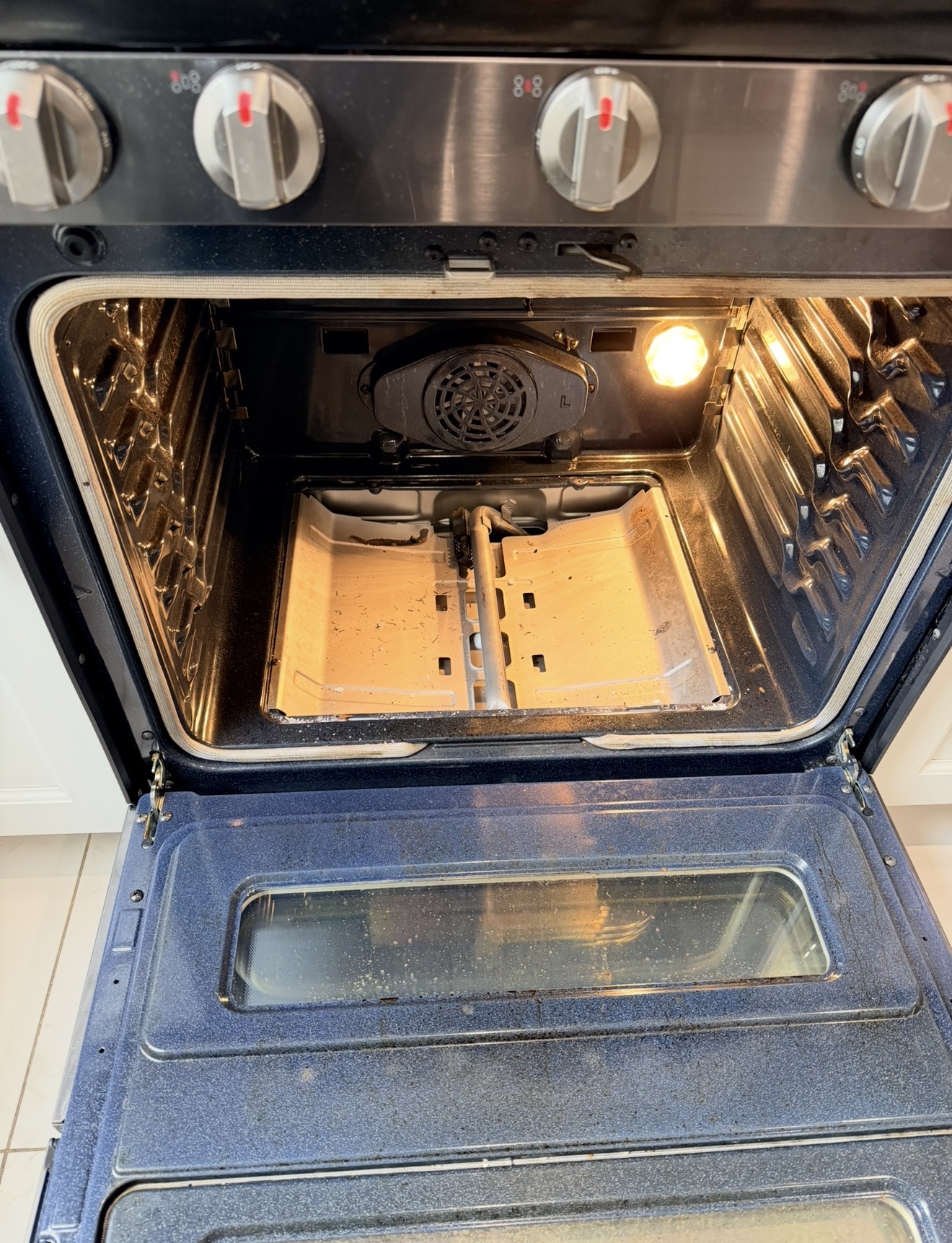
Independent of self-clean wear and convection issues, the underlying cause that crosses every Whirlpool gas oven sooner or later is bake igniter degradation. Set the oven to Bake 350°F with the oven light on, close the door, and watch through the window with a phone timer running. The sequence: within 30 to 60 seconds, a bright glow at the bottom of the cavity, ramping red → orange → white-hot. By around the 1-minute mark, the gas safety valve clicks open and a steady blue flame runs across the burner tube. By 90 seconds total, the burner is fully lit. If 90 seconds pass with the igniter glowing but no flame appears, the igniter is no longer drawing the threshold current the safety valve needs.
Mechanical detail: the Whirlpool gas oven igniter does two jobs simultaneously. It heats the gas to ignition temperature, and it acts as a current sensor that tells the gas safety valve when to open. As the igniter ages, its silicon-carbide element develops microcracks, its resistance climbs, the current it pulls drops, and at some point the safety valve no longer receives the threshold signal — so you get a glowing igniter with no flame. Multimeter spec: a healthy Whirlpool hot-surface oven igniter draws 2.5 to 3.6 amps under load. Below approximately 2.7 amps, the safety valve will not open. Below 2.0 amps, the igniter is fully spent. Resistance check at room temperature reads 80 to 175 ohms healthy; an open-circuit reading (infinite ohms) means the element is broken. The current-generation Whirlpool oven igniter is W10918546 and fits most current WFG and WEG gas ranges in Todt Hill kitchens — including WFG535S0LS, WEG745H0FS, WEG750H0HZ, WFG775H0HZ, and WFG975H0HZ. The newer WFG320 and WFG505 production series uses W11208965. Both fit most KitchenAid (KFGG500ESS, KFGS500ESS, KSGB900ESS), Maytag, and Amana gas ranges built by Whirlpool — sister brands on the same Whirlpool platform.
Why "Igniter Glows but No Flame" Is Almost Never the Gas Valve
One of the most common diagnostic mistakes — both DIY and from less-experienced techs — is to chase the gas safety valve when the symptom is glow-but-no-flame. The reasoning sounds right: "the gas isn't reaching the burner, so the valve must be bad." It almost never is. The gas safety valve in a Whirlpool gas oven is electrically simple — a solenoid that opens when it sees enough current through the igniter circuit. Valves rarely fail; igniters routinely degrade. When the igniter ages, its resistance climbs and the current drops below the valve's threshold. The valve is doing exactly what it should — refusing to open without confirmation that something hot is waiting to ignite the gas. Replacing the gas safety valve (98014893) on a glow-but-no-flame symptom replaces a working part. The actual fix is the igniter.
KitchenAid & Maytag — Same Whirlpool Platform, Same Visit
Whirlpool Corporation has owned KitchenAid since 1986, Maytag and its sister brands (Amana, Magic Chef, Jenn-Air) since 2006. From a service standpoint, that means the parts on a KitchenAid KFGG500ESS gas range, a Maytag freestanding gas, or an Amana gas oven are largely the same as on the equivalent Whirlpool — same igniters (W10918546, W11208965), same oven temperature sensors (WPW10181986), same door lock motors (WPW10107820), often built on the same factory line in Cleveland, Tennessee or Findlay, Ohio. We service all four sister brands at the standard $80 diagnostic. KitchenAid premium tier (KSGB900ESS, KFGS500ESS) sometimes has unique trim and a different control board, but the cavity-side parts are common. Bring the model number from the door frame label and we tell you which Whirlpool platform underlies it.
Why We Don't Quote Prices Over the Phone
A lot of shops quote a price on the phone and change it when they arrive. We don't. Two Whirlpool ovens with "won't heat" can need different parts: a weak igniter, a drifting sensor, a thermal fuse blown by a self-clean cycle, a gas safety valve, or a relay on the oven control board. Two double wall ovens with "lower cavity dead" can be one cavity's igniter or the shared control board — completely different repairs. The only way to know is to test on-site. You pay $80 for the diagnosis. You get the exact repair price in writing. You decide whether to proceed. If yes, the $80 is credited toward the repair. If no, you pay only the $80 and we leave. Same deal for every customer in Todt Hill, Dongan Hills, Grasmere, Emerson Hill, and Lighthouse Hill.
Whirlpool also builds a small electric range line, and we do see them occasionally in renovated Dongan Hills and Grasmere kitchens. Same diagnostic process; the failure modes shift to bake elements rather than igniters.
Why Choose Premier
Premier vs Whirlpool Service Center
Factor
Whirlpool Service
Premier Appliance
Arrival in Todt Hill
5–14 day wait
Same-day
Free phone advice before a visit
Queue & script
Always
Diagnostic fee
$100–150+
$80, applied
Price quoted before work starts
Not always
Always in writing
Warranty
Varies
90-day guarantee
Weekend availability
Weekdays only
Mon–Sun
Honest, Transparent Pricing
What a Visit Costs
Diagnostic
$80
On-Site Diagnosis
Flat fee, anywhere in 10304. Covers travel, complete on-site diagnosis of your Whirlpool, KitchenAid, Maytag, or Amana gas range, oven, double wall oven, or convection unit — including the bake igniter timing test, lock motor function check, and convection fan listening test where relevant — and a written repair quote. Applied toward the repair if you proceed.
$0
Hidden Fees
No weekend charge. No trip fee. No fuel surcharge. No North Shore surcharge. Price quoted before work starts and locked in.
How the repair price is determined: After diagnosis, Badma gives you the exact price in writing. It depends on which part failed and your specific Whirlpool, KitchenAid, Maytag, or Amana model — a bake igniter, an oven temperature sensor, a thermal fuse, a door lock motor, a convection fan motor, a gas safety valve, and a control board are all different repairs at different prices. We don't guess over the phone because two ranges with the same symptom can need different parts. You approve the price before any work starts. Every completed repair carries a 90-day parts and labor warranty.
Whirlpool F-Code & KitchenAid Diagnostics in Todt Hill Premium Kitchens
Todt Hill kitchens run premium-tier Whirlpool, KitchenAid, and Maytag ovens harder than typical households — heavy entertaining means more cycles per year on door lock motors, convection fans, and oven temperature sensors. That shifts which F-codes appear most. Self-clean codes (F5-E1, F5-E2) and sensor codes (F3-E0, F3-E1) are over-represented here vs. lower-utilization ZIPs.
F5-E2 / F5-E1Door Lock Did Not Engage at Self-Clean Start — Most Common in 10304▼
F5-E2 means a self-clean cycle (AquaLift or pyrolytic) attempted to start but the door lock motor did not engage. F5-E1 means the door was not detected as fully closed when the cycle was commanded. In 10304, where high-volume entertaining households run self-clean more frequently than typical kitchens, lock motor wear is the single most-replaced failure mode after igniter degradation.
Open and close the door firmly — sometimes a stiff hinge or compressed gasket keeps the switch from registering closed.
Inspect the perimeter gasket (W11542153) for compression that holds the door slightly open.
Power cycle at the breaker for 5 minutes.
If F5-E2 or F5-E1 returns on a self-clean attempt, do not retry — repeated attempts with a failed lock damage the latch.
Fix is usually the door lock motor and switch assembly (WPW10107820) — same-visit replacement, stocked on the truck. Call (929) 261-4444 →
No Code · Igniter TestDisplay Normal, Cooktop Fine, Oven Stays Cold — How to Test the Igniter at Home▼
A specific failure pattern: panel lights up and responds to button presses, cooktop burners ignite normally, no F-code anywhere on the display. But Bake mode produces no heat. The most common explanation across Whirlpool gas ranges from the WFG775 through the KitchenAid KSGB900ESS lines is a hot-surface igniter that has aged past the threshold needed to open the safety valve. The test below is what we run on-site, and it works just as well from the homeowner side.
Start with a cold oven so you can see the timing clearly. Bake 350°F, oven light on, door closed, timer running from the moment Start is pressed.
Through the window: by the 30-to-60-second mark, expect a visible glow at the bottom of the cavity. The element progresses red, then orange, then white-hot. Around the 1-minute mark the safety valve should click and a steady blue flame should appear across the burner tube. Total ignition by 90 seconds.
Reading the result — if the glow shows but no flame ever arrives by 90 seconds, the igniter is no longer drawing the threshold current the safety valve needs. Replacement is the fix.
If the glow stops at red or orange and never reaches white-hot, the element is failing but still functional. It will fail completely soon. Replace before it does.
If nothing glows by 60 seconds, the circuit is open — broken wire, fully dead igniter, or in rare cases a control board relay fault.
Both Whirlpool oven igniter generations live on the truck — W10918546 covers the WFG775H0HZ, WFG975H0HZ, WEG745H0FS, WEG750H0HZ premium ranges typical in 10304 kitchens, and W11208965 fits newer WFG320 and WFG505 production runs. Same-visit replacement. Call (929) 261-4444 →
F3-E0 / F3-E1Oven Temperature Sensor — Open or Shorted (Common During Self-Clean)▼
F3-E0 means the sensor circuit is open — broken wire, disconnected harness, or sensor that has failed open. F3-E1 means the sensor or its wiring has shorted. Either way, the control board can no longer read oven temperature accurately and shuts off heat to prevent unsafe operation. In Todt Hill specifically, sensor failures often appear during or right after a self-clean cycle, because the cavity heat stresses the sensor's connections more than normal cooking does.
Power cycle at the breaker for 5 minutes — clears soft glitches.
Set Bake 350°F. If F3-E0 or F3-E1 returns within the first minute, sensor or wiring has hard-failed.
If the code cleared and doesn't come back during a full bake cycle, the issue was a transient — monitor for a few days.
Sensor (WPW10181986) is the standard fix; same-visit replacement. On a Whirlpool double wall oven where only one cavity throws F3-E0 or F3-E1, only that cavity's sensor needs replacement — not both. Call (929) 261-4444 →
No Code · Convection FanConvection Fan Grinding, Whining, or Won't Spin▼
Convection fan motor wear is one of the two failure modes we see over-represented in Todt Hill premium kitchens. The motor sits on the back of the oven cavity and circulates hot air during convection cooking. Bearings get noisy at 7 to 10 years of regular convection use; entertaining households see this 1 to 2 years sooner.
Set the oven to a non-convection bake mode first. If bake works correctly, the issue is isolated to the convection circuit.
Listen during a convection cycle. Faint whining = early bearing wear. Audible grinding = bearings scoring, replace before failure. Silent fan with convection mode active = motor seized.
Power cycle 5 minutes; rules out a transient sensor or relay reading.
Convection fan motor replacement is a same-visit repair on most Whirlpool TimeSavor and KitchenAid premium-tier ovens. Call (929) 261-4444 →
F1-E0 / F1-E1EEPROM Communication or Checksum Error▼
F1-E0 indicates the oven control board cannot read its EEPROM calibration memory. F1-E1 is a checksum error on the same memory. Both can clear themselves after a long power cycle if the trigger was a transient, or persist if the EEPROM has corrupted.
Power cycle at the breaker for a full 5 to 10 minutes (longer than the usual 30 seconds).
Wait at least 1 minute after power returns before pressing anything.
If F1-E0 or F1-E1 clears and stays clear, the trigger was transient. Monitor for a few days.
If the code returns within hours or days, the EEPROM has hard-failed. On premium KitchenAid units (KFGG500ESS, KSGB900ESS) and Whirlpool Smart-line ovens, the control board is the highest-priced individual repair on the truck. We never quote board replacement without first confirming the code is persistent and ruling out simpler causes.
Standard Whirlpool WFG and WEG control boards are typically same-day; KitchenAid premium-tier may be special-order. Call (929) 261-4444 →
F2Runaway Temperature Cutoff — Stop Using the Oven Until Inspected▼
F2 alone (without an E-suffix) signals that the cavity climbed past the safe upper limit and the runaway-protection logic intervened. This is meaningfully different from F2-E0 or F2-E1, which point at the touch keypad. A bare F2 indicates either welded relay contacts on the control board (the bake or broil relay closed and stuck closed, feeding heat continuously regardless of what the controls were asking for), or a control board logic fault. Until the cause is identified, the appliance is unsafe to operate.
Range breaker to OFF — do not retry the oven.
Allow a full cool-down period of two hours minimum before any access work begins.
(929) 261-4444 for a same-day diagnosis. We test relay contact integrity on the board, the temperature sensor (WPW10181986) for a stuck-low reading that could have caused over-firing, and the wiring harness for any short to chassis. Replacement of the oven control board is the typical repair path.
F2 is the rare code where same-day matters for safety reasons rather than convenience reasons. Call (929) 261-4444 →
F2-E0 / F2-E1Touch Keypad Stuck or Disconnected▼
F2-E0 means the control reads a button as continuously pressed when nothing is being pressed — almost always food splatter, grease film, or moisture on the panel. F2-E1 means the touch panel cable has lost connection to the control board. KitchenAid premium touch panels (KFGG500ESS, KSGB900ESS) are particularly sensitive to even small amounts of cooking residue across the membrane.
Wipe the touch panel with a damp microfiber cloth — never spray cleaner directly onto it.
Inspect each button area in good light for any chip, crack, or physical depression.
Power cycle at the breaker for 5 to 10 minutes.
If F2-E0 clears, you are done. If it returns, the membrane switch or its ribbon to the board has failed.
Whirlpool and KitchenAid touch panels are generally reliable but moisture and grease build-up cause issues over time. Call (929) 261-4444 →
F4-E1Meat Probe Defect or Probe Circuit Issue▼
F4-E1 indicates a problem with the meat probe, the probe receptacle in the oven cavity, or the probe circuit on the control board. KitchenAid premium-tier ovens get more meat-probe use than typical kitchens — Todt Hill households often run probes for roasting holiday meals — so receptacle wear shows up here.
Remove the probe and inspect the cable for pinch damage, cuts, or melted insulation.
Inspect the receptacle in the oven cavity for grease, baked-on residue, or moisture across the contact pins.
Reinsert the probe firmly and re-test. If F4-E1 persists, the probe assembly itself has failed.
If F4-E1 throws even with the probe disconnected and removed, the receptacle wiring or control input has failed.
PF means the oven detected a brief interruption to its power supply — press Cancel and reset the clock. A single PF after a confirmed outage is normal. If PF appears repeatedly with no obvious outage, the issue may be electrical (loose receptacle, voltage sag) rather than appliance — we test on-site. Sab indicates Sabbath mode is active. The display will show "Sab" and most controls will not respond. Hold the Sabbath button (or the button combination per the user manual for your specific KitchenAid or Whirlpool model) to exit. This catches Todt Hill households where a renter, guest, or housekeeper accidentally activated Sabbath mode and the homeowner doesn't recognize the display state.
The most distinctive Todt Hill repair pattern. Whirlpool WOD51EC0HS, WOD77EC0HS, and the equivalent KitchenAid double wall ovens have two complete oven systems sharing one control board and one display. When only one cavity fails, the cause is downstream of the shared electronics:
Confirm the symptom: which cavity heats, which doesn't. Try Bake 350°F in each cavity separately.
The most-failed component is the bake igniter for the affected cavity — same igniter family as freestanding ranges (W10918546 most current units; W11208965 newer production series).
Second-most-failed is the cavity oven temperature sensor (WPW10181986) — affected cavity heats but never reaches set temperature, the other cavity behaves normally.
Third is door gasket compression (W11542153) on the failing cavity letting heat escape during the cycle.
If both cavities are completely dead, the issue is upstream — the shared control board, ribbon cable, or internal power supply.
Diagnosis takes about 20 minutes. Both cavity igniters and sensors stocked on the truck for same-visit repair. Call (929) 261-4444 →
Cooktop ignites fine but the oven cavity stays cold — typical Whirlpool failure at 6-10 years▼
This particular split — burners working, oven not — points almost always at the bake igniter rather than the gas supply or the controls. The pattern is consistent enough across the Whirlpool premium tier (WFG775H0HZ, WFG975H0HZ) and KitchenAid platform (KFGS500ESS, KSGB900ESS) that on most Todt Hill calls we know what we are diagnosing before opening the access panel. Quick at-home check before scheduling a visit:
Cold start matters — run the test from a cool oven so the timing reads true.
Bake 350°F, oven light on, door closed, phone timer running.
Watch the bottom of the cavity. The element should brighten through red and orange to white-hot inside the first minute, then the safety valve should click and a blue flame should run the length of the burner.
If you see a steady glow but no blue flame after 90 seconds, the element resistance has climbed beyond the spec range. The valve is not getting the current signal it needs. Replacement is straightforward.
If the cavity stays dark for the first minute, the circuit is open — usually a broken element rather than a wiring fault, but worth confirming on-site with a continuity check.
Technician detail: 2.5 to 3.6 amps under load on a healthy igniter; under 2.7 amps the valve solenoid will not open.
Two igniter part numbers cover the current Whirlpool, KitchenAid, Maytag, and Amana installed base on Staten Island — W10918546 for most production runs and W11208965 for newer WFG320/WFG505 builds. Both stocked. Call (929) 261-4444 →
AquaLift self-clean won't finish or door stays locked after the cycle▼
AquaLift is the gentler steam-clean cycle on newer Whirlpool and KitchenAid ovens — runs about 200°F for 40 minutes with water poured into the cavity floor. Three failure modes in 10304 entertaining households where self-clean runs frequently:
F5-E2 at the start of the cycle. Door lock motor (WPW10107820) failed to engage. This is the most-replaced part in 10304. Same-visit fix.
F3-E0 or F3-E1 mid-cycle. Oven temperature sensor (WPW10181986) reads incorrectly during the cycle and the control aborts. Same-visit fix.
Cycle ended but door stays locked, no error. Wait the full 1 to 2 hours for the cavity to cool below the lock-release threshold. After that, breaker OFF for 10 minutes, breaker ON. If still locked, the lock motor has failed. Don't force the door — call us.
Older units use traditional pyrolytic self-clean (~800°F for 2-4 hours) instead of AquaLift; pyrolytic stresses door lock motors and surrounding components more than AquaLift does, so households running monthly pyrolytic self-clean see lock failures sooner. Call (929) 261-4444 →
Convection fan grinding, whining, or won't spin in convection mode▼
Whirlpool's TimeSavor convection ranges and KitchenAid premium-tier convection ovens have a known wear pattern on the convection fan motor — bearings get noisy at 7 to 10 years of regular convection use. In Todt Hill, where households run convection 3 to 5 times more often than typical, we see this 1 to 2 years sooner. Three stages:
Stage 1 — faint whining only during convection mode. Easy to dismiss. Bearings drying out. Fan still spins normally; convection still works correctly.
Stage 2 — audible grinding that gets louder over weeks. Bearings scoring. Fan still spins but the noise is now noticeable from across the kitchen. This is the right time to replace.
Stage 3 — fan stops spinning entirely. Convection mode either throws a fan-related fault or simply doesn't activate the fan while bake mode continues to function. Motor has seized.
To test: set the oven to a non-convection bake first to confirm bake works. Then attempt a convection cycle and listen. Audible bearing wear means motor replacement; same-visit repair on most Whirlpool and KitchenAid models. Call (929) 261-4444 →
Whirlpool oven preheats but never reaches 350°F or 400°F▼
Different from "won't heat at all." Here the oven heats some, the display climbs, but it never actually reaches the set temperature. Common after years of heavy entertaining use. Two main causes:
Drifting oven temperature sensor. The Whirlpool oven sensor (WPW10181986) is an RTD mounted on the back wall of the cavity. With age, its resistance curve drifts and the control board reads a falsely high temperature, so it shuts off heat before the actual cavity reaches the set point. Quick test: a $6 oven thermometer on the middle rack, set Bake 350°F, wait 20 minutes, compare actual to displayed. More than 35°F low = sensor needs replacement.
Worn door gasket on entertaining-heavy units. The W11542153 door gasket compresses over thousands of bake cycles. When the seal weakens, heat escapes during the cycle and the cavity loses temperature faster than it gains. Visually inspect the gasket — torn, flattened, or missing in spots = needs replacement. Often replaced at the same time as the sensor on units running heavy use.
Badma checks both with a multimeter test on the sensor and a visual inspection of the gasket — same visit. Call (929) 261-4444 →
KitchenAid touch panel unresponsive or showing F2-E0▼
KitchenAid premium-tier touch panels (on KFGG500ESS, KSGB900ESS, and similar) are sensitive to cooking residue across the membrane. F2-E0 means the control reads a button as continuously pressed when nothing is being pressed.
Wipe the touch panel with a damp microfiber cloth — never spray cleaner directly onto buttons. Even small amounts of grease in front of a button can register as a false press.
Inspect each button area under bright light for any chip, crack, or physical depression.
Power cycle at the breaker for 5 to 10 minutes.
If F2-E0 returns despite a clean panel, the membrane switch under the touch surface or the control board has failed.
F2-E1 is a different failure — the touch panel ribbon cable has lost connection to the main board. Same-visit repair on most KitchenAid models. Call (929) 261-4444 →
Persistent gas odor at the appliance — what is the right sequence?▼
This is utility-company territory before it is appliance-repair territory. A brief whiff at burner ignition is normal mercaptan released as gas first flows through the orifice. An ongoing odor when nothing is cooking is not, and the response sequence matters.
Knobs to OFF, including any clock-timer cooking that may have started automatically.
Cross-ventilate — kitchen windows plus a door on the opposite side of the house if practical.
Avoid any electrical switching whatsoever — refrigerator door, light switch, garage opener, range hood fan; each can spark.
If the odor is strong, exit the residence with everyone inside.
From outside or a neighbor's phone: National Grid gas emergency, 1-718-643-4050. Free 24-hour response across Staten Island. They isolate gas at the meter when a leak is confirmed.
Only after National Grid has cleared the residence: (929) 261-4444 for the appliance-side repair that produced the leak.
Live leaks fall explicitly outside our scope — that is utility work and should not be touched by appliance technicians. Once gas is safely isolated, the most common appliance-side culprits in Todt Hill kitchens are a worn flexible connector at the range hookup, a failed gas safety valve solenoid (98014893), or a damaged orifice on a cooktop burner from a years-old food-spillover incident. Same-visit repair on all three after the safety clearance. Call after the safety clearance →
Whirlpool gas oven only lights when a stovetop burner is on first▼
A diagnostic-grade clue most homeowners don't realize they're seeing: the oven only fires the burner when one of the cooktop burners is already lit. The mechanism is straightforward — a stovetop burner draws a small additional current through the same circuit, which can be just enough to push a borderline-weak bake igniter past the threshold the gas safety valve needs to open.
Confirm the symptom: cold oven start, set Bake 350°F, wait the full 90 seconds — does the burner ignite? If no, light a single cooktop burner and watch the oven window. Does the bake burner now light?
If yes, that confirms a weak oven igniter. The igniter is glowing and pulling some current, just not enough on its own to open the safety valve.
The igniter is W10918546 on most current Whirlpool gas ranges or W11208965 on the newer WFG320/WFG505 production series — both stocked on the truck.
This symptom catches a degrading igniter early. Catch it now and the oven keeps working through the holidays; ignore it and the oven will fail completely within a few weeks — a particularly bad outcome heading into a Todt Hill family entertaining season. Call (929) 261-4444 →
Your Technician
About Badma
BadmaOwner & Technician · Premier Appliance Repair Staten Island LLC
4+ Years on Whirlpool, KitchenAid & Maytag Across Premium Staten Island KitchensHundreds of premium Whirlpool gas ranges (WFG775, WFG975, WEG745, WEG750), KitchenAid (KFGG500ESS, KFGS500ESS, KSGB900ESS), Maytag, and Amana sister-brand gas units diagnosed in Todt Hill, Dongan Hills, Grasmere, and Emerson Hill. Plus Whirlpool double wall ovens (WOD51EC0HS, WOD77EC0HS) common in 10304 entertaining kitchens.
Bake Igniter Glow Test & Current-Draw Diagnosis On-SiteWhirlpool gas oven igniter timing test through the window, then multimeter check of igniter current under load. A healthy hot-surface igniter draws 2.5 to 3.6 amps; below ~2.7 amps the gas safety valve will not open. We catch borderline igniters before they fail completely — important heading into entertaining season.
Self-Clean & Convection Cycle Wear Specialist10304 entertaining households run more cycles per year than typical kitchens. Door lock motors (WPW10107820) and convection fan motors are the parts replaced most often after igniters. Three-stage convection bearing diagnosis catches grinding fans before they seize. AquaLift and pyrolytic self-clean failure modes both diagnosed on-site.
Both Whirlpool Oven Igniter Generations + Critical Wear Parts on the TruckW10918546 (covers most current WFG/WEG and KitchenAid/Maytag/Amana sister-brand gas ranges including WFG775H0HZ, WFG975H0HZ, WEG745H0FS, WEG750H0HZ, KFGG500ESS, KSGB900ESS) and W11208965 (newer WFG320/WFG505 production series). Plus WPW10181986 oven temperature sensor, W11542153 door gasket, WPW10107820 door lock motor and switch assembly, WP9759242 thermal fuse, 98014893 gas safety valve.
$80 Flat Diagnostic — Exact Price AfterWritten quote before any work starts. No phone guesses, no surprise fees. We sometimes recommend pairing related repairs (lock motor + gasket on a unit running heavy self-clean) and explain why on-site so you can decide.
90-Day Parts & Labor WarrantyEvery completed repair — backed by Premier Appliance Repair Staten Island LLC directly. No third-party paperwork.
The Repair Process
How a Whirlpool or KitchenAid Repair Visit Works in 10304
1
Call or Book — Share Your Model and Symptom
Call (929) 261-4444 or book online. Have two things ready: the Whirlpool, KitchenAid, Maytag, or Amana model number from the label inside the door frame (it starts with WFG, WEG, WOS, WOD, WOSA, KFGG, KFGS, KSGB, MGR, or AGR), and what you're actually seeing — the F-code on display, whether the igniter glows, whether self-clean was running when it failed, which cavity of a double wall oven is affected, whether the convection fan is making noise. The model tells Badma which igniter to load (W10918546 for most units, W11208965 for the newer WFG320/WFG505 series) and whether it's a single or double wall oven. Some 10304-typical issues — Sabbath mode accidentally activated by a guest, AquaLift door cool-down not yet finished, F4-E1 from a probe receptacle that just needs cleaning — get solved over the phone in 5 minutes at no cost.
7 Days a Week
2
On-Site Diagnosis — $80 Flat (Includes Cycle-Wear Inspection in 10304)
Badma arrives, inspects the range or wall oven, and runs the test sequence specific to what you described. For "won't heat" — the igniter timing test through the oven window, then a multimeter check of igniter current draw (healthy 2.5 to 3.6 amps; below ~2.7 amps the gas safety valve will not open). For double wall ovens with one cavity dead — testing each cavity's igniter, sensor, and gasket independently. For self-clean failures (F5-E1, F5-E2) — door lock motor function, switch continuity, gasket compression. For convection issues — non-convection bake confirmation followed by listening test on convection mode for the three-stage bearing wear pattern (whining → grinding → seized). The $80 covers the visit and full diagnosis regardless of how long it takes. On premium KitchenAid units we also visually inspect the touch panel for residue patterns that cause F2-E0 false-press codes.
3
Written Quote — Exact Price Before Any Work
You get the exact repair price in writing: the specific Whirlpool, KitchenAid, Maytag, or Amana OEM part, its cost, and the labor. For 10304 entertaining households, we sometimes recommend replacing two related parts at once — for example the door lock motor and the door gasket on a unit running heavy self-clean, or the bake igniter and the oven sensor on a 10-year-old wall oven approaching end-of-life on both — because doing them together avoids a return visit when the second part fails six months later. We always explain the reasoning before quoting it; you decide which parts to do. If you approve, the $80 diagnostic applies toward the total. If you decide to wait or get a second opinion, you pay only the $80 and Badma leaves. No pressure, no upsell.
4
Repair Done — Same Visit When Part Is On Truck
Most common Whirlpool, KitchenAid, and Maytag gas oven parts ride on the truck for same-visit repair: bake igniters W10918546 and W11208965 (covering essentially every Whirlpool, KitchenAid, Maytag, and Amana gas range and wall oven in 10304 households), oven temperature sensor WPW10181986, oven thermal fuse WP9759242, gas safety valve 98014893, door gasket W11542153, door lock motor and switch assembly WPW10107820. In 10304 specifically, the door lock motor is the part replaced most often after the igniter, because high-volume entertaining households run self-clean cycles more often than typical kitchens — 30-minute swap on most Whirlpool and KitchenAid models. Convection fan motors and KitchenAid premium-tier control boards are sometimes special-order, installed on a second visit typically 1 to 3 business days. Every completed repair carries a 90-day parts and labor warranty backed directly by Premier Appliance Repair Staten Island LLC
90-Day Warranty
Serving Todt Hill & Surrounding Neighborhoods
Todt Hill — ZIP 10304
Todt Hill is the highest ground in Staten Island — and at 410 feet, the highest natural elevation along the Atlantic Coast between northern Maine and southern Florida. The neighborhood sits along Ocean Terrace, Todt Hill Road, and Four Corners Road through estate-sized lots and large single-family homes. Dongan Hills runs down the eastern slope along Richmond Road and Hylan Boulevard toward the harbor. Grasmere sits around Grasmere Pond and the Grasmere SIRT station along Hylan. Emerson Hill is the slope between Todt Hill and Grymes Hill, accessible from Douglas Road. Lighthouse Hill — a quiet residential area off Lighthouse Avenue — holds the historic Staten Island Range Lighthouse and the Jacques Marchais Museum of Tibetan Art. These are the kitchens where we see Whirlpool premium-tier units (WFG775H0HZ, WFG975H0HZ, WEG750H0HZ slide-in gas), Whirlpool double wall ovens (WOD51EC0HS, WOD77EC0HS), and KitchenAid sister-brand premium gas (KFGG500ESS, KFGS500ESS, KSGB900ESS) most often — large kitchens designed for heavy entertaining. The two failure modes we see over-represented here are self-clean cycle wear (door lock motors WPW10107820, the part replaced most often after igniters) and convection fan motor bearing wear (TimeSavor convection ranges, KitchenAid premium-tier ovens — bearings noisy at 7 to 10 years of regular use). Badma covers the full area same-day: Todt Hill Road, Ocean Terrace, Four Corners Rd, Richmond Rd, Hylan Blvd, Sea View Ave, Douglas Rd, Lighthouse Ave, Manor Rd, and throughout Todt Hill, Dongan Hills, Grasmere, Emerson Hill, and Lighthouse Hill.
Todt Hill Dongan Hills Grasmere Emerson Hill Lighthouse Hill Todt Hill Rd Ocean Terrace Richmond Rd Hylan Blvd Manor Rd Sea View Ave Douglas Rd
Whirlpool & KitchenAid Oven Questions — Todt Hill 10304
Is there a minimum repair charge?+
Yes. Every completed repair has a $180 minimum labor charge, and your $80 diagnostic is applied toward it. We're a licensed, insured shop and back every repair with a 90-day parts-and-labor warranty - so even a quick fix gets the same workmanship and guarantee, not a temporary patch. If parts are needed, they're quoted on-site before any work, and nothing starts without your approval.
My Whirlpool double wall oven upper cavity works but the lower one won't heat. What's wrong?+
Whirlpool and KitchenAid double wall ovens — common in Todt Hill kitchens (WOD51EC0HS, WOD77EC0HS, plus the equivalent KitchenAid units) — run two completely separate oven systems sharing one control board and one display. When only one cavity fails, that tells us the issue is downstream of the shared electronics: in the cavity-specific igniter, gas safety valve, oven temperature sensor, or wiring harness for that one oven. Diagnosis takes about 20 minutes on-site. The most-failed component on a 6-to-10-year-old double wall oven where one cavity stops heating is the bake igniter for that cavity (W10918546 covers most current units; W11208965 the newer production series). Second-most-failed is the cavity oven temperature sensor (WPW10181986) drifting on one side. Third is a worn door gasket on the failing cavity letting heat escape so the oven looks like it's not reaching set temperature. Both igniters and sensors are stocked on the truck for same-visit repair. If both cavities are dead, the issue moves upstream to the shared control board — different repair, also same-day. Call (929) 261-4444.
My KitchenAid range AquaLift self-clean cycle won't finish or ends in an F-code. What now?+
AquaLift is the low-temperature steam-clean cycle on newer Whirlpool and KitchenAid ovens — runs about 200°F for 40 minutes with water poured into the cavity floor, much gentler than traditional pyrolytic self-clean which runs 800°F+ for 2 to 4 hours. AquaLift cycles fail in three ways. First, the door lock did not engage at the start — F5-E2 is the typical code. Door lock motor (WPW10107820) is the fix; this is the part most-replaced in Todt Hill kitchens because high-volume entertaining households run self-clean more often than typical homes. Second, the oven temperature sensor reads incorrectly during the cycle and the control aborts — F3-E0 or F3-E1, sensor (WPW10181986) is the fix. Third, on older units that use traditional pyrolytic self-clean instead of AquaLift, the door stays locked because the cavity has not cooled below approximately 200°F internal — wait the full 1 to 2 hours after the cycle ends before expecting the door to release. If after a full cool-down and a 10-minute breaker reset the door is still locked, the lock motor has failed. Don't force the door — call (929) 261-4444.
Whirlpool gas oven won't heat, igniter glows but no flame — what's the fix in Todt Hill?+
Glow-but-no-flame is the dominant Whirlpool gas oven failure pattern in the 6-to-10-year service window. Two functions live in one component: the silicon-carbide element heats hot enough to ignite the gas stream, and the current it pulls through the circuit is what tells the gas safety valve to open. Wear on the element raises its resistance over time, drops the current draw below the valve threshold, and at that point you see ignition heat with no fuel arrival — the valve is doing exactly what it should, refusing to release gas without confirmation that something hot waits to ignite it. Chasing the safety valve (98014893) on this symptom is the most common diagnostic mistake. Spec we measure on-site: 2.5 to 3.6 amps draw on a working hot-surface igniter under load. Below roughly 2.7 amps, the safety valve stays closed. Below 2.0 amps, the element is fully spent. Resistance at room temperature: 80 to 175 ohms healthy. Whirlpool stocks two igniter generations covering the entire current Todt Hill installed base — W10918546 for most production runs of WFG775H0HZ, WFG975H0HZ, WEG745H0FS, WEG750H0HZ, and the equivalent KitchenAid premium tier (KFGG500ESS, KFGS500ESS, KSGB900ESS); W11208965 for newer WFG320 and WFG505 builds. Both ride on the truck for same-visit replacement. Maytag and Amana gas ranges built on the Whirlpool platform fit one of these two parts as well.
My Whirlpool convection fan is grinding or won't spin. Is that fixable same-day?+
Yes, in most cases. Convection fan motors on Whirlpool's TimeSavor convection ranges and on KitchenAid premium-tier ovens have a known wear pattern: bearings get noisy at 7 to 10 years of regular convection use. In Todt Hill, where high-volume entertaining households use convection more often than typical, we see this failure mode 1 to 2 years sooner than in lower-utilization kitchens. Symptoms in order of progression: faint whining only during convection mode, then audible grinding that gets louder over weeks, then fan stops spinning entirely (oven displays a fan-related fault or convection mode simply doesn't function while bake mode still works). Diagnosis is straightforward — set the oven to a non-convection bake first to confirm bake mode is fine, then attempt a convection cycle and listen. Audible bearing wear means motor replacement; same-visit repair on most Whirlpool and KitchenAid models. Call (929) 261-4444.
Whirlpool or KitchenAid oven shows F1-E0 or F1-E1. Should I replace the control board?+
F1-E0 indicates an EEPROM communication failure — the oven control board cannot read its calibration memory. F1-E1 indicates an EEPROM checksum error. Industry repair guidance for both is the same: power-cycle at the breaker for at least 5 to 10 minutes (longer than the usual 30 seconds), wait at least 1 minute after power returns, and see if the code reappears. If it clears and stays clear, the EEPROM glitch was a transient — monitor for a few days. If F1-E0 or F1-E1 returns within hours or days, the EEPROM is corrupted and the control board has hard-failed. On premium KitchenAid units (KFGG500ESS, KSGB900ESS) and Whirlpool Smart-line ovens, control boards are the highest-priced individual repair on the truck — typically a special-order part installed on a second visit unless we have stock. On standard Whirlpool WFG and WEG ranges the control board is also higher than igniter or sensor work but available faster. Either way, we never quote board replacement without first running the EEPROM-clearing protocol and confirming the code is persistent. Call (929) 261-4444.
How much does Whirlpool or KitchenAid oven repair cost in Todt Hill?+
The diagnostic is $80 flat — covers the trip to your Todt Hill, Dongan Hills, Grasmere, Emerson Hill, or Lighthouse Hill address, full on-site diagnosis, and a written quote. After diagnosis, the repair price depends on which part failed and your specific Whirlpool or KitchenAid model. We don't guess over the phone because two ovens with the same "won't heat" symptom can need different parts — a bake igniter, an oven temperature sensor, a thermal fuse, a door lock motor, or a control board are all different repairs at different prices. Whirlpool igniters and sensors are mid-priced repairs in the Staten Island appliance market. Door lock motor replacement (the most-frequent repair after self-clean wear in entertaining households) sits in a similar range. Convection fan motor replacement runs higher. KitchenAid premium-tier control boards and double wall oven shared assemblies are the highest. You get the exact number in writing before any work starts. If you approve, the $80 applies toward the total.
I smell gas near my Whirlpool range — what should I do first?+
Do NOT try to fix this yourself. Turn the range OFF at all knobs. Open windows for ventilation. Do not flip light switches, do not use lighters or matches, do not plug or unplug anything — a single spark can ignite accumulated gas. Call National Grid's 24-hour gas emergency line at 1-718-643-4050. They respond free of charge anywhere on Staten Island and will shut off the gas supply at the meter if there is a confirmed leak. Only after National Grid clears the situation and the area is safe, call us at (929) 261-4444 to repair the range part that caused the issue. We do not service live gas leaks — that is utility-company work. Once the gas is verified safe, we fix the appliance.
Do you service all of Todt Hill, Dongan Hills, Grasmere, and Emerson Hill?+
Yes — the full 10304 ZIP. Todt Hill on the highest ground in Staten Island along Todt Hill Road, Ocean Terrace, and Four Corners Road. Dongan Hills along Richmond Road and Hylan Boulevard down toward the harbor. Grasmere around Grasmere Pond and Hylan Boulevard. Emerson Hill on the slopes between Todt Hill and Grymes Hill. Lighthouse Hill near the historic lighthouse and Richmondtown. Same diagnostic price and same warranty regardless of where in 10304 you are. Same-day service 7 days a week: Mon–Fri 8 AM – 10 PM · Sat–Sun 9 AM – 5 PM.
What Whirlpool and KitchenAid models do you repair?+
Every Whirlpool gas range, slide-in, freestanding, and wall oven that turns up in Staten Island kitchens, plus the KitchenAid, Maytag, and Amana sister-brand gas units built on the same Whirlpool platform. Common premium-tier models in 10304 households where the bake igniter, oven temperature sensor, gas safety valve, or door lock motor is the failed part: WFG775H0HZ, WFG975H0HZ, WEG745H0FS, WEG750H0HZ slide-in gas. Whirlpool gas wall ovens: WOS51EC0HS, WOS51EC0HW single, WOD51EC0HS, WOD77EC0HS double wall oven, WOSA2EC0HZ Smart wall oven. KitchenAid premium: KFGG500ESS, KFGS500ESS, KSGB900ESS premium dual-burner range. Maytag and Amana gas ranges built by Whirlpool fit the same igniter (W10918546 or W11208965 depending on production series), the same oven sensor (WPW10181986), and the same door gasket (W11542153). If you have a different Whirlpool, KitchenAid, Maytag, or Amana gas model, call with the model number from the label inside the door frame and we will tell you which igniter generation and which oven sensor your unit takes.
How long is the warranty?+
Every completed repair carries a 90-day parts and labor warranty. If the same issue returns within 90 days, Badma comes back and fixes it at no additional charge. The warranty is backed directly by Premier Appliance Repair Staten Island LLC — no paperwork to file with a third party. The $80 diagnostic itself is not warranted (it covers the on-site visit and inspection), but every repair we perform is. For 10304 specifically: in Todt Hill kitchens where high-volume entertaining puts more annual cycles on Whirlpool and KitchenAid premium-tier units than typical homes, we sometimes recommend replacing two related parts together (for example the door lock motor and the gasket on a unit running heavy self-clean) rather than one — and we explain why on-site so you can decide. Two-part jobs still get one warranty period covering both.
Ready to Fix It
Whirlpool or KitchenAid Down in Todt Hill? Try the DIY Steps First — Then Call Us
Same-day service across ZIP 10304. $80 diagnostic, exact repair price after we see the problem, 90-day warranty on every completed repair.