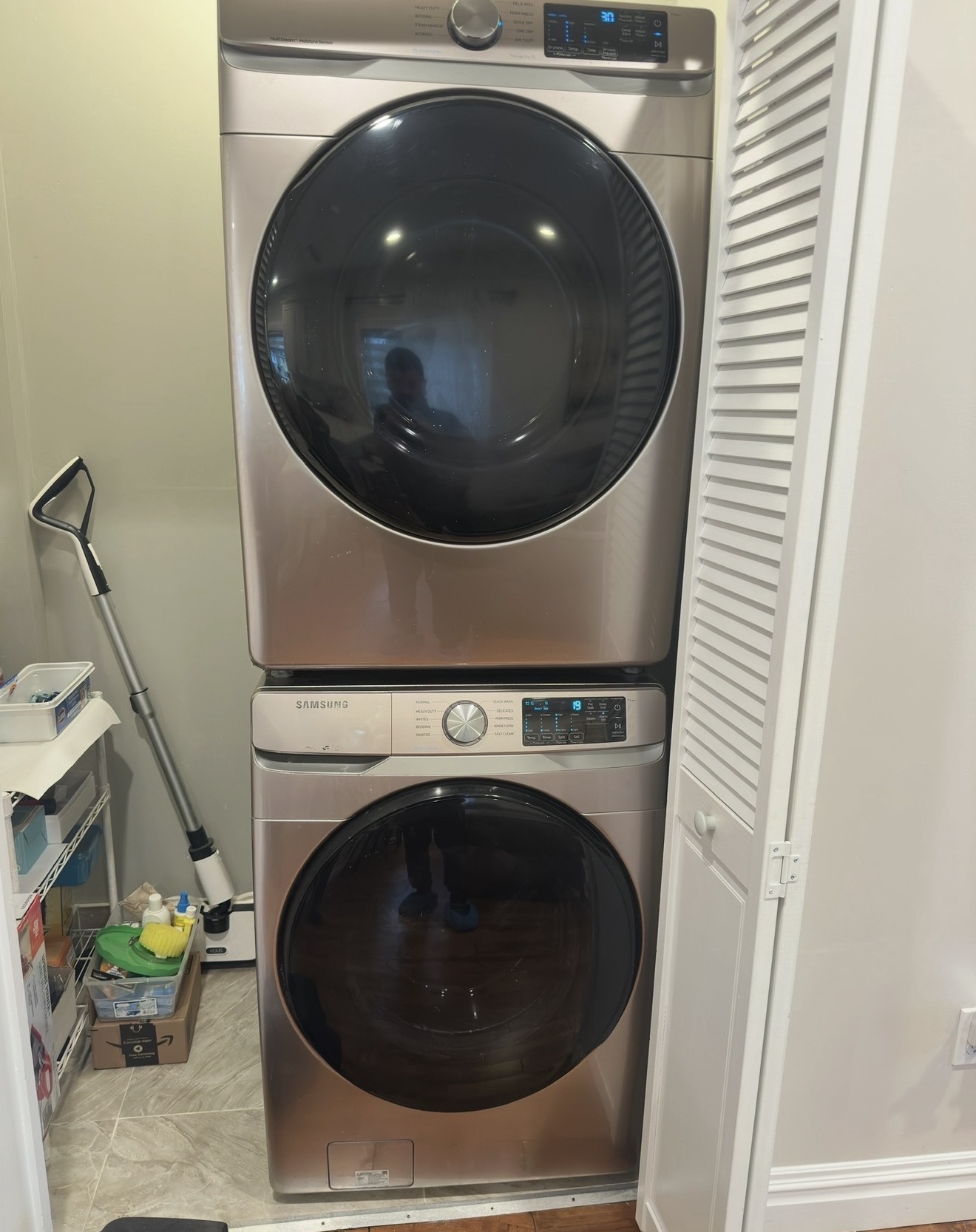
Samsung Dryer Repair
in New Springville.
HC1 from long horizontal duct runs in ranch and raised-ranch subdivision homes — diagnosed and fixed same-day in 10314.
HC1 from long horizontal duct runs in ranch and raised-ranch subdivision homes — diagnosed and fixed same-day in 10314.
$80 service call · Applied to your repair · Price quoted before any work starts
Why New Springville & Willowbrook residents call us for Samsung dryer repair:
New Springville, Willowbrook, and Bull's Head occupy the geographic center of Staten Island — mid-island residential neighborhoods built out primarily during the suburban expansion of the 1980s through the early 2000s. The housing stock along Richmond Avenue, Manor Road, Watchogue Road, and the residential side streets is predominantly ranch-style and raised-ranch construction: single-story or split-level homes with wide footprints built on flat or gently graded lots. These are newer homes by Staten Island standards — and that newer construction turns out to produce a specific dryer vent problem that doesn't exist in the North Shore prewar apartments or the South Shore cape cods this series has already covered.
The issue is floor plan geometry. Ranch and raised-ranch homes are wider than they are deep. The dryer in a 10314 home is typically in a utility room positioned somewhere in the interior of that wide footprint — not against an exterior wall. To exit the building, the exhaust duct has to travel horizontally across a substantial portion of the house's width before it can reach a side or rear wall. These runs are often 15 to 20 feet or more, with one or two direction changes where the duct navigates around structural elements. The duct material in most of these installations is corrugated flexible duct — standard in subdivision construction because it bends easily around obstructions during installation. The combination of a long horizontal run and corrugated walls creates exactly the conditions that produce HC or HC1: lint settles into the corrugation valleys along the entire duct length rather than being swept through cleanly, and builds up in progressively thickening deposits until airflow restriction triggers the Samsung's overtemperature protection.
This is different from vent problems in other parts of Staten Island. In Tottenville, Raritan Bay humidity makes lint adhesive. In Silver Lake, masonry walls force circuitous duct routing. In New Springville and Willowbrook, the cause is purely geometric — a straightforward relationship between floor plan width, duct length, and the physics of lint transport in horizontal corrugated duct. The homes are relatively new. The dryers may only be ten years old. Neither suggests a vent problem to the homeowner. But the duct configuration was never optimally designed for long-term lint management, and HC1 is the consequence when accumulation crosses the restriction threshold.
The exterior vent cap is the easiest thing to check and the first thing we ask callers to inspect. In New Springville and Willowbrook, the cap often looks completely clean — the interior duct restriction is the issue, not the exit point. Lint accumulates progressively from the dryer end inward: the heaviest buildup is close to the machine, in the first several feet of duct where the lint concentration in the exhaust airflow is highest, and at each corrugation wave and directional change further along the run. This buildup doesn't appear at the cap because it never makes it that far. We assess the accessible duct section from the dryer end, clear what we can reach, and give you an honest assessment of what's further in — including whether a duct cleaning specialist is needed for sections through finished walls or enclosed utility spaces.
Bull's Head, running south along Richmond Avenue, has older construction mixed into the newer subdivision homes — some 1960s and 1970s cape cods and split-levels that predate the ranch-home era. These older homes have shorter duct runs but older flex duct that has never been replaced. Aged corrugated duct develops more pronounced surface roughness as the material degrades, which accelerates lint adhesion even in shorter runs. The HC1 pattern in Bull's Head comes from duct material age rather than duct length — the mechanism is the same, the geometry is just different.
Heavy lint accumulation along the duct interior — the result of long horizontal corrugated duct runs in New Springville ranch homes — and the internal components inspected on every 10314 HC call.
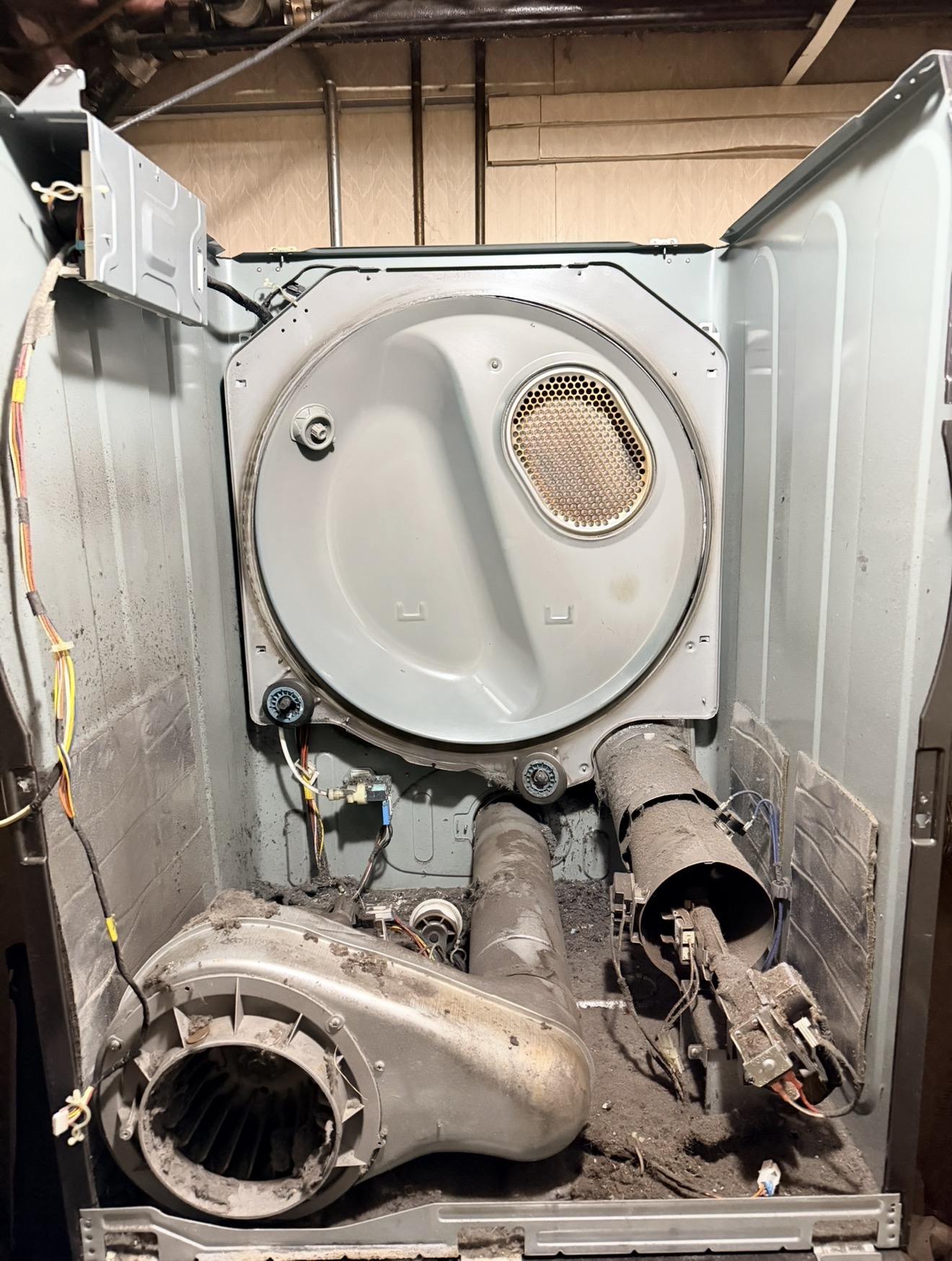
Duct lint accumulation — New Springville HC1 call
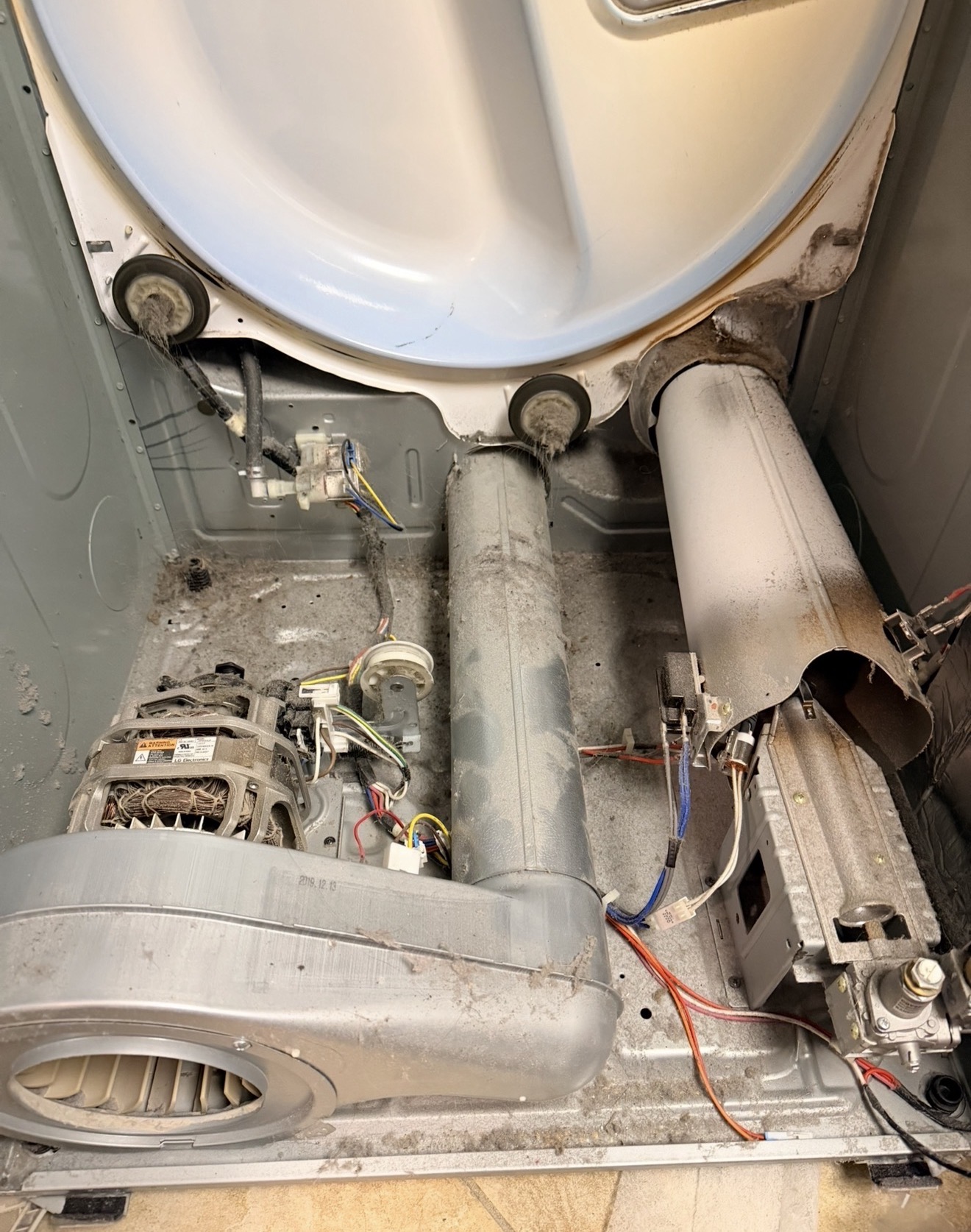
Internal assessment — thermal fuse and heating circuit
The $80 covers travel to anywhere in 10314, vent assessment from the dryer end, thermal fuse test, heating element check, and a written quote before any work begins. For ranch and raised-ranch homes with long horizontal duct runs, we assess the accessible section and are clear about what extends further and whether a duct specialist would be needed for those sections.
Prices subject to NY state sales tax (8.875%).
Five Samsung dryer error codes that come up regularly in 10314. HC / HC1 is open by default — the primary fault driven by long horizontal duct geometry in this area.
HC or HC1 means exhaust temperature has exceeded the safe limit from restricted airflow. In New Springville and Willowbrook ranch homes, the duct may look clean at the exterior cap while a substantial lint buildup has developed inside the long horizontal run — invisible from the outside, building up from the dryer end inward over months of normal use.
HE or HE1 after a period of HC1 means the thermal fuse has tripped. The dryer was overheating from the long duct restriction, HC1 appeared and was reset, and the fuse eventually opened the heating circuit. HC1 can no longer appear once the fuse has blown — the heating circuit is open. We replace the fuse and assess the accessible vent section on the same visit to address the restriction that caused the overtemperature sequence.
tC or tC1 means the exhaust thermistor circuit returned an out-of-range reading. In 10314, a tC code appearing alongside or after HC1 events may indicate that repeated overtemperature cycles have stressed the thermistor's connector or the sensor housing itself. We test the thermistor in isolation from its connector and inspect the harness on every call where tC accompanies HC1, to determine whether the sensor, the connector, or both need attention.
Call (929) 261-4444dF means the Samsung's door switch isn't confirming the door is fully latched. In raised-ranch utility rooms where the dryer is positioned below grade with limited headroom, the door is sometimes pulled sideways or at an angle when loading — this gradually wears the latch strike. Check whether the door clicks firmly into place. If it closes but dF persists across multiple cycles, the door switch assembly needs replacement.
Call (929) 261-4444FE means the Samsung detected AC line frequency outside its acceptable range. Like the related 9C1 voltage code, FE indicates a power supply issue rather than a dryer fault — the machine is accurately reporting what it sees from the outlet. In residential settings, AC frequency is supplied by the utility and is normally very stable. FE codes in 10314 homes typically trace to a utility supply irregularity or a loose outlet connection rather than anything wrong with the dryer itself. We test the outlet on arrival. If the outlet reads correctly and FE was a one-time event, no dryer repair is needed.
Call (929) 261-4444When HC1 codes are reset repeatedly and the dryer keeps running through overtemperature events, the thermal fuse eventually trips and the heating circuit opens permanently. The fuse doesn't reset. Once blown, HC1 can no longer appear because the heating circuit is open — so the dryer runs cold with no code. Thermal fuse replacement and vent assessment from the dryer end are addressed on the same visit.
When cap cleaning provides temporary relief from HC1 but the code returns on a regular cycle, the restriction source is inside the duct itself — not at the cap. In New Springville and Willowbrook ranch homes with long horizontal flex duct, lint builds up progressively in the interior of the run. Clearing the cap reduces restriction at the exit point but doesn't address the interior accumulation that continues to restrict airflow. We assess the accessible duct section from the dryer end and advise on what's further in.
Extended drying time in a 10314 home is an early indicator of interior duct restriction — the buildup is significant enough to reduce exhaust efficiency but hasn't yet reached the threshold that triggers HC1. In ranch homes with long horizontal flex duct, this is the stage to address the duct before the thermal fuse sequence begins. We also clean the Samsung's Sensor Dry moisture bars, which accumulate fabric softener residue over time and cause the machine to under-detect remaining moisture, ending cycles before clothes are fully dry.
When HC1 appears on a relatively new Samsung dryer in a New Springville or Willowbrook home — one that's only five to eight years old — the machine itself is usually fine. The duct configuration is the issue: a long horizontal corrugated flex duct run that was installed correctly to code but was never optimally designed for long-term lint management. We assess the duct from the dryer end, clear what's accessible, and discuss whether the duct configuration could be improved with a shorter or smoother installation.
Call (929) 261-4444 or book online. Describe the HC1 code or no-heat symptom, whether the exterior cap looked clean when you checked it, and whether your home is a ranch or raised ranch with a central laundry room. We confirm same-day arrival in 10314.
Same-day in New Springville & WillowbrookThe accessible duct section is assessed from the dryer end. The thermal fuse continuity and heating element are tested. You receive a written quote covering every component and an honest assessment of the duct — including how far the accessible section extends and whether any part of the run would need a duct specialist.
The accessible duct section is cleared from the dryer end. If the thermal fuse has blown, it's replaced on the same visit. For duct sections through finished walls, enclosed utility spaces, or attic runs that require a duct cleaning specialist, we give you an accurate picture of what's accessible and what isn't — and never claim the accessible clearing is the full solution when it isn't.
Honest duct assessment — every HC callThe dryer runs a complete heated cycle before we leave. You receive a 90-day parts and labor warranty. If HC1 returns within 90 days, we come back at no charge and reassess — the duct configuration and what was accessible during the first visit is documented for any follow-up.
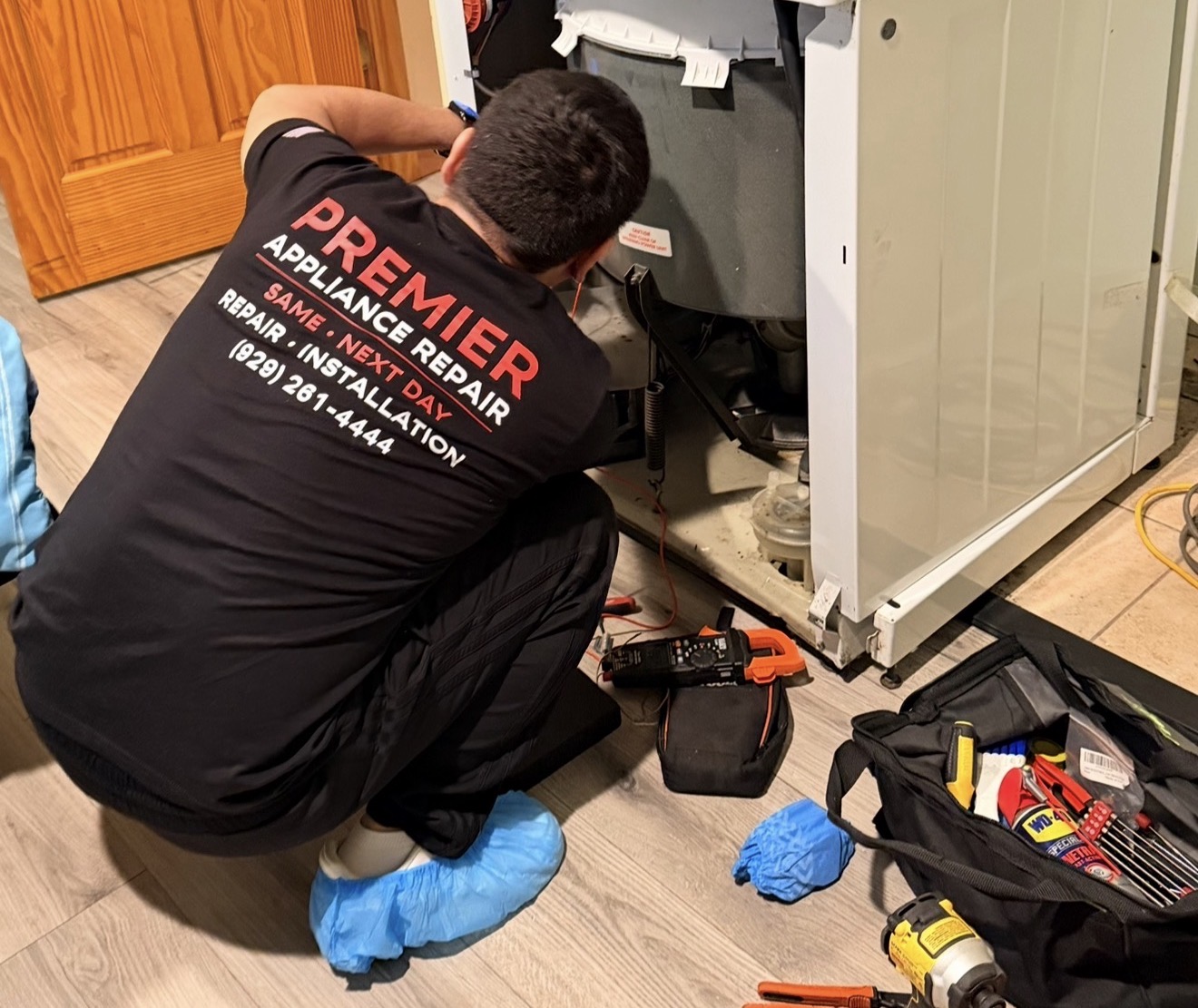
Access in 10314 varies by home type. Ranch homes along Manor Road and Watchogue Road typically have a ground-floor or attached-garage utility room accessible through the main entrance or a side door. Raised-ranch homes — common on the residential streets between Richmond Avenue and Willowbrook Road — have the laundry room on the lower level, accessible through a separate entrance or an interior stairway. In raised-ranch configurations, the duct often exits through a lower-level wall on the side of the house, with the horizontal run traveling through the crawl space or utility area beneath the main floor.
10314 is a mid-island route stop — Richmond Avenue and the surrounding streets are central to Staten Island, with no distance concern. Same-day service, no surcharge.
"Great! Very responsible and fast! They replaced my dishwasher motor and some other parts that needed to be replaced. Recommend them!"
"They came in, identified the problem, gave me an assessment of my appliance then resolved the issue. Quick efficient service at a reasonable price."
"Premier appliance was fantastic. Badma was professional and fixed my dishwasher with no issue. I highly recommend premier appliance."
"Great service! Arrived on time, quickly diagnosed my LG washer not draining, had the part on hand, and fixed it."
"I called Premier to come and inspect my Kitchenaid dishwasher. I have not been able to use it for a few days cause it was leaking. They came right away and fixed it."
"My washing machine suddenly broke and I was completely desperate. I contacted Premier Appliance Repair Staten Island, and Badma came the very same day!"
Yes. Every completed repair has a $180 minimum labor charge, and your $80 diagnostic is applied toward it. We're a licensed, insured shop and back every repair with a 90-day parts-and-labor warranty - so even a quick fix gets the same workmanship and guarantee, not a temporary patch. If parts are needed, they're quoted on-site before any work, and nothing starts without your approval.
HC1 means exhaust temperature has exceeded the safe limit from restricted airflow. In New Springville, Willowbrook, and Bull's Head, the fault comes up regularly from ranch and raised-ranch homes where the duct travels 15 to 20 feet horizontally before it can exit. Long horizontal corrugated flex duct runs accumulate lint along the full interior length — gravity doesn't assist clearance the way it does in vertical duct sections. Check the exterior cap before booking: if it's clear and HC1 keeps returning, the restriction is inside the duct run.
Newer construction doesn't mean shorter duct runs. Ranch homes and raised ranches built in New Springville subdivisions from the 1980s through the 2000s have wide floor plans with laundry rooms positioned in the interior — the duct has to travel further to reach an exterior wall. The corrugated flex duct installed in these homes is standard and code-compliant, but it's less efficient at clearing lint than smooth rigid duct in shorter runs. HC1 on a machine that's only eight or ten years old is usually a duct configuration issue, not a defective dryer.
A clean exterior cap means the restriction is inside the duct, not at the exit point. In ranch homes with long horizontal flex duct, lint builds up progressively from the dryer end inward — heaviest close to the machine where lint concentration in the exhaust is highest, and at each corrugation wave further along the run. It doesn't appear at the cap because it builds up before it gets that far. We assess from the dryer end to address where the restriction actually is.
We assess and clear the accessible duct section from the dryer end on every HC call. In ranch homes where the duct travels through a crawl space, enclosed utility area, or finished ceiling over a long horizontal distance, we clear what we can reach and give you an accurate picture of what's further in. For sections that require a duct cleaning specialist to access, we tell you directly — we don't claim the accessible clearing is the full solution.
Yes. That sequence — HC1 followed by no heat with no displayed code — is the thermal fuse blowing. HC1 means the dryer was overheating; the fuse trips when overtemperature events accumulate. Once blown, the heating circuit is open and HC1 can't reappear. We replace the fuse and assess the accessible vent section on the same visit to address the restriction that caused the sequence.
10314 is on the mid-island route — Richmond Avenue and the surrounding residential streets are central to Staten Island. After booking or calling, we confirm same-day arrival. If the laundry room is on the lower level of a raised ranch or accessed through a separate entrance, mention it when you book. Mon–Fri 9 AM – 7 PM · Sat 9 AM – 5 PM · Closed Sunday, no weekend surcharge.
All major Samsung electric and gas dryer models: DV45T6200 series, DV50R5200 series, DV42H5200 series, DVG45T6200 gas models, DV25BB6900H Bespoke series, and DV6500 FlexDry. Call (929) 261-4444 with your model number to confirm before booking.
90-day parts and labor warranty on every repair. If HC1 returns or any replaced component fails within 90 days, we come back at no charge. For New Springville homes with long duct runs, we document what was accessible during the first visit — if HC1 returns within the warranty period, that record guides the follow-up assessment.
HC1 from a long horizontal flex duct run in a New Springville ranch, a clean cap with interior accumulation, a thermal fuse blown after HC1 was ignored — we're on the mid-island route and can be at your door on Richmond Ave, Manor Rd, or anywhere in 10314 same-day. Accessible duct cleared, honest assessment of what's further in.